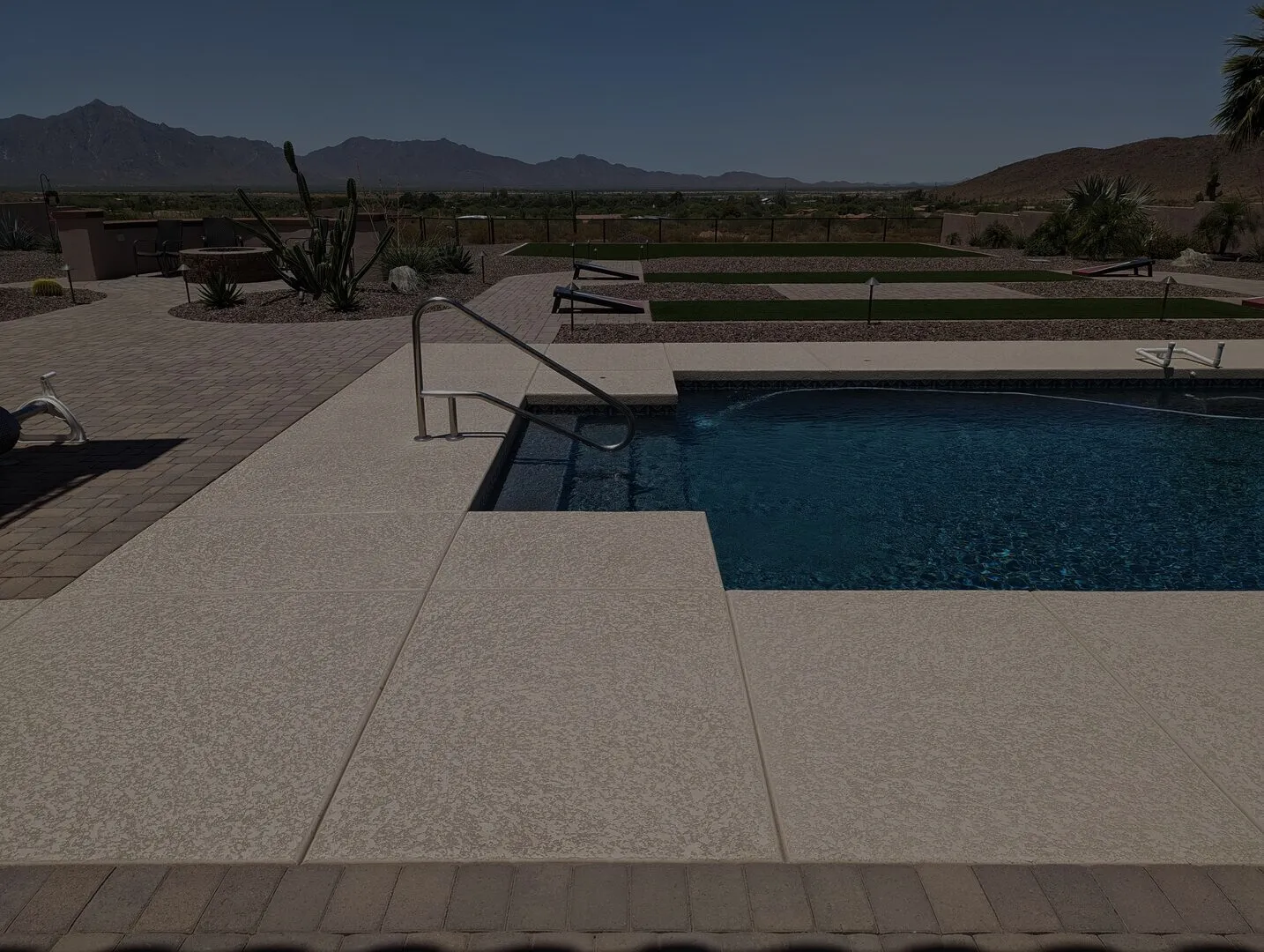




We turn down work over this. Somebody wants a deck resurfaced, we walk it, and the honest answer is that no coating we can install will fix what is actually wrong. Putting a beautiful finish on a failing slab produces a beautiful finish that fails, and the customer paid for both.
The replace vs resurface concrete question is usually framed as a budget decision. It is not. It is a structural one, and the slab answers it. There are specific conditions where resurfacing is the wrong call regardless of how much someone wants to avoid replacement, and they are identifiable in an afternoon.
Two existing guides on this site handle the normal version of this decision. Our piece on the signs your pool deck needs resurfacing covers when a sound deck is ready for attention, and pool deck repair versus resurfacing covers choosing between two levels of the same solution. Both assume the slab is worth saving. This article is about the cases where it is not.
What a resurfacing can genuinely fix
Start with the honest positive, because most slabs are fine.
An overlay or a coating handles surface problems well. Cosmetic and hairline cracking. Discoloration and staining. Worn or dated finishes. Minor surface spalling where the body of the slab is sound. Poor texture and slip resistance. Small level irregularities. It can also make a meaningful change to a deck’s temperature and appearance without touching the structure.
Those are surface conditions and a surface solution addresses them. The line is whether the concrete underneath is still doing its job.
Replace vs resurface concrete: six conditions that decide it
Vertical displacement at a crack. Lay a straightedge across a crack. If one side sits higher than the other, that is displacement, and no coating bridges a step. An overlay applied over it produces a visible ridge, a crack that reappears in the same place, and a trip hazard that is now yours to explain. Displacement means the slab has broken into pieces that are moving independently.
Ongoing movement. A crack that is still opening is a different problem from a crack that opened once and stopped. The test is time: mark both sides of a crack with a scribe or a bridging patch of plaster, note the date, and check it across a full season. Movement over months means the soil beneath is still working, and a rigid surface applied over active movement fails on the soil’s schedule rather than yours. Our page on crack repair before coating installation covers the dormant cases that are repairable.
Widespread delamination of the concrete itself. Not the coating, the concrete. The top layer of a slab can separate from the body below it, and when that has happened over a large area there is nothing sound to bond to. The test is sound. Drag a length of chain across the surface, or tap with a hammer. Solid concrete rings. Delaminated concrete gives a dull hollow tone that you can hear immediately once you have heard the difference. Isolated hollow spots get cut out and patched. A deck that sounds hollow across a third of its area is not a resurfacing candidate.
Corroding reinforcement. Steel that is rusting expands, and that expansion breaks concrete outward from the inside. It shows as rust staining, cracks running in straight lines that follow the reinforcement pattern, and spalled areas with visible steel. Once reinforcement is exposed and actively corroding across an area, the deterioration continues under any coating you install because the mechanism is inside the slab.
Voids and undermining. Soil erodes from under a slab through drainage washouts, a plumbing leak or a pool shell leak. The slab is then partly unsupported. You can hear it and often feel it: hollow sound in the field of the slab rather than at the surface, and sometimes a detectable flex underfoot on a thinner residential pour. Coating an unsupported slab does nothing about the void, and the slab will eventually crack into the space.
Grade and drainage that cannot be corrected in a surface layer. This is the most commonly missed one. If a deck slopes toward the house, ponds water, or sits at the wrong elevation relative to coping or a threshold, an overlay has very little thickness to work with. Meaningful re-sloping is not a surface problem and pretending otherwise produces a deck that looks new and drains exactly as badly as before.
Two more that are judgment calls
Elevation constraints. Sometimes the slab is sound but there is nowhere to put the added thickness. A door threshold with no clearance, a pool coping detail that would end up below deck level, an existing transition that cannot move. Overlays add height, and when even a modest build is not available the options narrow to a thin coating or replacement. This is worth checking before anyone falls in love with a finish.
Repeated failure history. If a deck has taken three coatings in eight years and lost all three, the coatings are not the variable. Something about the substrate, the moisture condition or the soil is defeating every system applied to it. At that point the money is better spent finding out what it is, and often better spent on replacement, than on a fourth attempt with a different product.
The forty minute assessment
Anyone can do most of this before calling a contractor.
- Straightedge every significant crack. A four foot level laid across the crack tells you in seconds whether there is vertical displacement.
- Sound the slab. Tap across the whole surface with a hammer, or drag a chain. Mark the hollow areas with chalk and look at how much of the deck they cover.
- Run a hose. Wet the deck and watch where water goes and where it stops. Ponding tells you about slope. Water disappearing at a crack tells you about a void.
- Look for rust. Orange staining bleeding out of cracks or spalls means reinforcement is corroding.
- Mark the cracks and wait. If anything is ambiguous, mark and date the cracks and look again in three months. Time answers the movement question better than any inspection does.
Take photographs of what you find. A contractor arriving to a deck that has already been sounded and marked has a much better conversation with you.
When to bring in somebody other than a coating contractor
There is a category of finding that is outside what a coating company should be assessing.
Vertical displacement over a significant area, suspected voids under the slab, cracking that appears to relate to the structure of the house rather than the flatwork, and anything involving a pool shell should go to a structural engineer or the relevant specialist. That is not a deflection, it is the correct referral. A coating contractor telling you a displaced and undermined slab is fine to overlay is either inexperienced or selling.
Similarly, if the working hypothesis is a leak, find the leak first. A pool leak detection service or a plumber answers that question in a way that no amount of surface work does.
When replacement is the answer, what comes next
Replacement is not a defeat, and it opens options that resurfacing does not.
A new slab can be poured at the right elevation with correct drainage, which fixes the ponding problem permanently. It can include a vapor retarder, which matters more in this market than most people expect. It can be sized and shaped to what you actually want rather than what was there in 1994. And once it has cured properly, it accepts any finish, which means a decorative concrete overlay or a coated finish goes on a substrate that will hold it.
Partial replacement is often the practical middle path. Replacing the failed section and resurfacing the whole area afterward gives a uniform appearance without the cost of a full tear out, and it is a common approach on larger decks where the problem is localized. That is frequently how a pool deck renovation ends up scoped.
Where the slab is sound, resurfacing remains the better value by a wide margin, and a pool deck resurfacing or a concrete overlay gives you a new surface without touching the structure. Localized damage on an otherwise good deck goes to pool deck repair instead.
We have been assessing Valley concrete for twelve years and we would rather tell you a slab is finished than take the job and watch it fail. Call our Chandler office at (602) 641-5892 and we will walk it with you and give you a straight answer.
Frequently asked questions
How do I know if my concrete needs replacing instead of resurfacing?
Look for structural symptoms rather than cosmetic ones. Vertical displacement at a crack, cracking that is still moving over months, widespread hollow sound when the slab is tapped or chain dragged, exposed and corroding reinforcement, voids underneath, and drainage problems that a thin surface layer cannot correct. Any of those means the concrete itself is the problem and no coating solves it.
Can an overlay fix a cracked concrete deck?
It depends entirely on the crack. A dormant shrinkage crack with no vertical displacement can be routed, filled and covered, and it stays fixed. A crack that is still moving will telegraph through, usually within a season. A crack with one side higher than the other cannot be covered at all, because no overlay bridges a step without leaving a ridge and a trip hazard.
What does hollow sounding concrete mean?
It means the top layer of the slab has separated from the body of the concrete below it, which is delamination within the concrete rather than a coating problem. Isolated hollow areas can be cut out and patched. When a large proportion of a deck sounds hollow, there is no sound surface for a new system to bond to and the slab needs replacing.
Is it cheaper to resurface than to replace concrete?
Resurfacing is the lower cost option when the slab is structurally sound, which is why it is usually the right answer. It stops being the cheaper option when the substrate is failing, because the new surface fails with it and you end up paying for the resurfacing and then the replacement. The structural assessment has to come before the budget comparison.