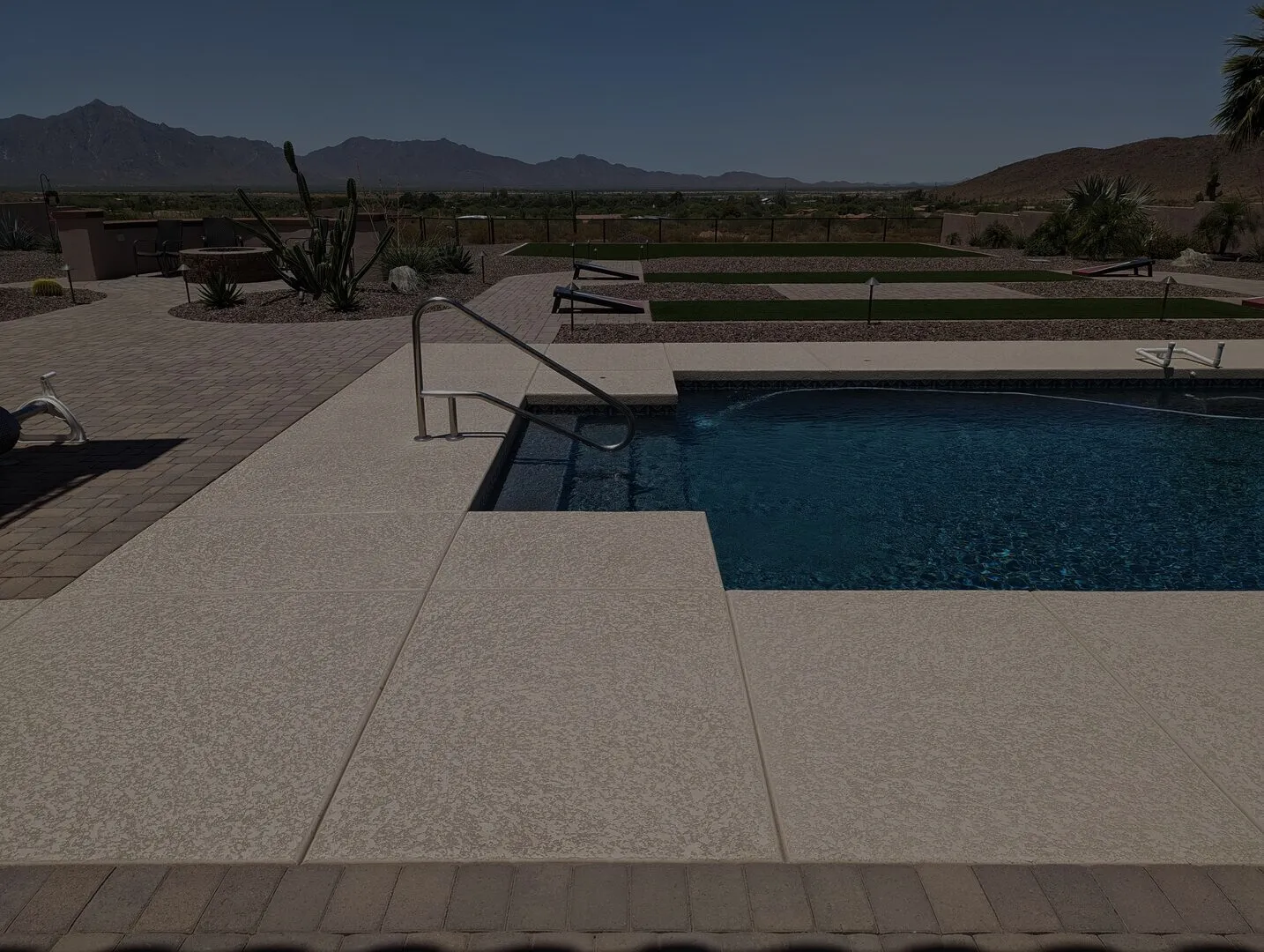



Nobody in Phoenix walks slowly across a pool deck in July. There is a specific hop-and-sprint that Valley kids learn before they learn to swim, and it exists because a concrete surface in direct sun gets hot enough to hurt.
A cool pool deck surface in Arizona is a real engineering outcome, not a marketing phrase. Four things control how hot a deck gets and how hot it feels, and they are not the same four things. Color and texture do most of the work, and one of them affects feel far more than it affects actual temperature.
The site already covers traction on a wet deck in some detail. This is the other half of the same design decision, and the two point in the same direction more often than people expect.
Why a deck gets hot in the first place
Sunlight hits a surface and the surface either reflects it or absorbs it. What gets absorbed becomes heat. That fraction is the property that matters, and color is by far the biggest lever on it.
A dark charcoal deck absorbs the large majority of the solar energy landing on it. A white or very light tan deck reflects a great deal more. In the middle of a Valley summer afternoon that difference is not subtle, and it is measurable with a cheap infrared thermometer in your own yard. Move the reading from a dark stamped border to a light field and watch the number drop.
Two other properties matter less but are worth knowing. Thermal mass determines how long the surface holds heat, which is why a thick concrete deck is still warm at nine at night while a thin paver over sand has already given its heat up. Emissivity determines how readily the surface sheds heat back to the sky once the sun is off it, and most masonry surfaces are similar enough here that it rarely drives a decision.
Texture changes how hot it feels, not how hot it is
This is the part that surprises people, and it is the single most useful thing in this article.
Your foot does not measure temperature. It measures heat flowing into it. That flow depends on how much of your skin is in contact with the hot surface and how fast the surface can deliver heat to that contact area.
On a smooth troweled deck, the sole of your foot touches almost everything. Full contact, fast heat transfer, immediate pain. On a knockdown texture or a heavy trowel-textured overlay, your foot rides on the high points. The contact area is a fraction of what it was, the low areas hold air, and air is a poor conductor. The surface can be reading the same temperature and feel dramatically better underfoot.
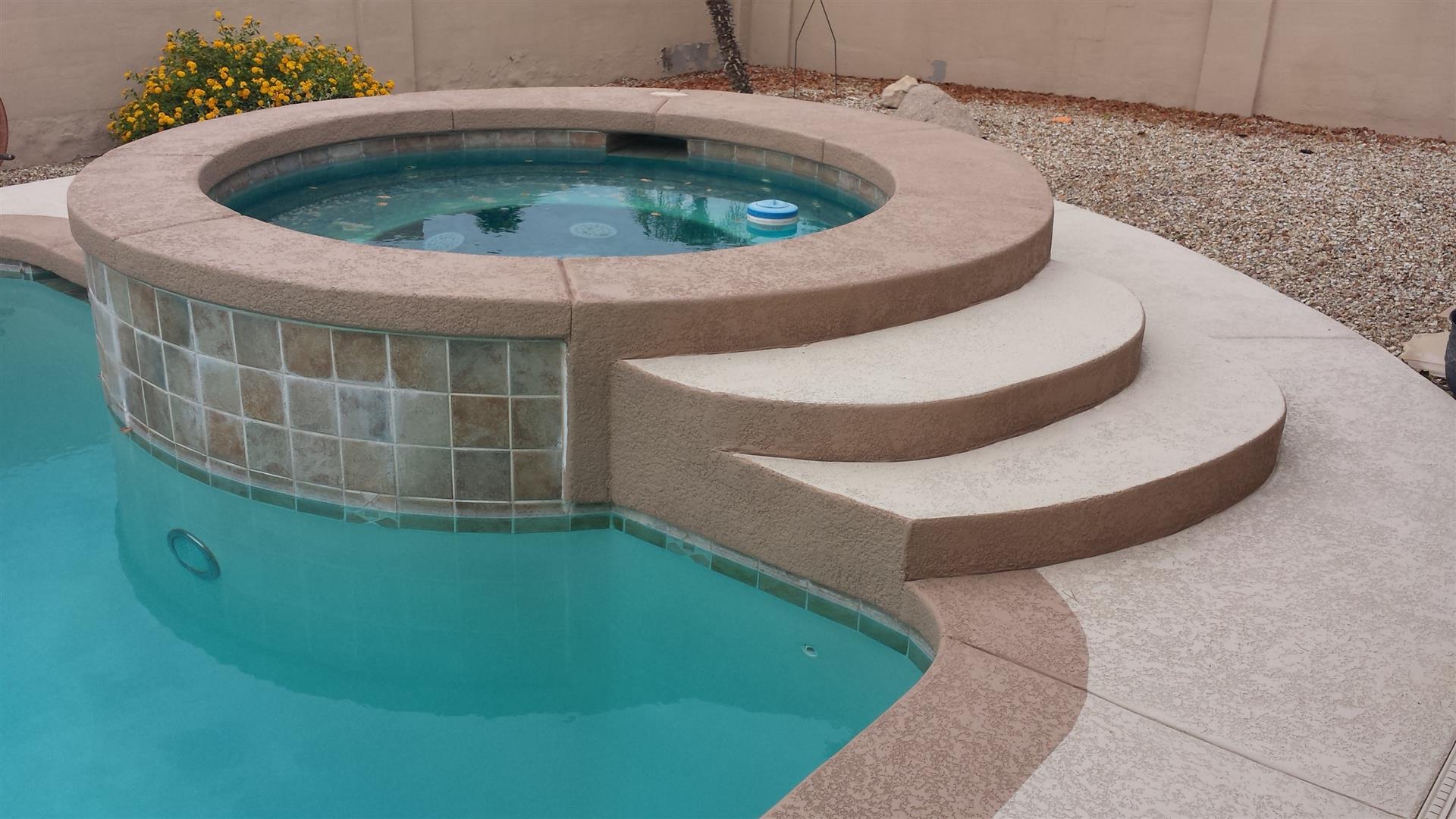
That is why the classic Arizona pool deck finish is a textured acrylic or cementitious knockdown rather than a smooth one, and why a textured concrete pool deck is usually the right specification here on both counts. It happens to be the same finish that gives you traction on a wet surface, which is the useful coincidence in this whole subject. Our pages on skid resistant pool deck coating and slip resistant pool deck surfaces cover the traction side of the same texture decision.
There is a limit. Texture aggressive enough to be uncomfortable on bare feet, or to skin a knee, has gone too far. The target is a profile that breaks contact without being abrasive, and getting that right is a matter of technique on the knockdown pass rather than product choice.
What each surface actually does
Comparing the common Valley options on heat alone:
- Bare gray concrete, smooth trowel. Mid-range absorption, full contact, high mass. The baseline, and it is a hot baseline.
- Acrylic knockdown, light color. The traditional cool deck finish. High reflectance from the color, broken contact from the texture, and a thin coating layer that does not add much mass. This is why it became standard here.
- Cementitious overlay, light color, textured. Same benefits, more durability, more design flexibility. A concrete overlay is the modern version of the same idea.
- Travertine and light natural stone. Genuinely good on heat. Pale color, and the porous structure of travertine helps. It is also the most expensive path and it comes with its own maintenance.
- Concrete pavers. Depends almost entirely on the color chosen. A light buff paver performs well. A charcoal paver is one of the hottest surfaces you can put around a pool.
- Dark stamped concrete. The worst combination available: dark color and a relatively smooth surface between the pattern lines. Beautiful, and hot.
None of this makes stamped concrete a bad choice, and plenty of Valley homes have a stamped concrete pool deck that works well. It means the color selection carries more weight on a stamped deck than on any other surface, because the texture is not going to save you.
Color selection with heat in mind
The practical rule is simple. Lighter is cooler, and the difference between a light and a dark version of the same product is larger than the difference between two different products at the same color.
Whites and very pale grays are the coolest and the hardest to keep looking clean, and in full Valley sun a bright white deck produces enough glare to be genuinely unpleasant. Light tans, sands and warm grays are the practical sweet spot: most of the reflectance, far less glare, and they hide dust, which matters here more than anywhere.
Dark accent bands and borders are a reasonable compromise. A charcoal border on a light field gives you the design contrast without putting a hot surface where people stand. Keep the dark material out of the main walking path and off the area between the door and the pool. Our color charts are the place to have this conversation, and it is worth having with exposure in mind rather than picking on a screen.
The lever that beats all of them
Shade. Nothing in the coating world competes with it.
A surface that never receives direct sun stays near air temperature, which in a Phoenix August is still hot but is nowhere near the surface temperatures we have been discussing. A shade sail over the primary walking path, a ramada over the seating area, or a strategically placed tree changes the experience of a deck more than any product decision available.
The corollary is that the coating decision matters most exactly where shade is not possible: the pool coping, the perimeter walkway, the path from the door. Those are the surfaces to spend the design attention on.
Misting systems help too, though for a different reason. Evaporative cooling works well in low humidity, which is most of the Valley year, and drops badly during monsoon when the air is already carrying moisture. A mister is a summer afternoon tool, not an all-season one.
What to ask for when you resurface
If barefoot comfort is a priority, say so explicitly at the quoting stage, because it changes three decisions.
It moves the color selection toward the lighter end of whatever product line you are choosing. It argues for a textured finish over a smooth one, which is also the safer choice wet. And it affects the layout, since the walking paths and the pool perimeter are where the light textured surface belongs even if a darker material is used elsewhere for design reasons.
Those three choices together do more than any single product claim. We have been resurfacing decks across the Phoenix metro for twelve years and this is one of the few areas where the physics is simple, the tradeoffs are honest, and the right answer is usually available at any budget. If you want to talk through a pool deck resurfacing with heat as a design input, call our Chandler office at (602) 641-5892 for a free estimate.
Frequently asked questions
What is the coolest pool deck surface for Arizona?
A light colored, textured surface. That means a pale acrylic knockdown, a light cementitious overlay with a textured finish, or a pale natural stone such as travertine. Color does most of the work by reflecting solar energy, and texture does the rest by reducing how much of your foot touches the surface at any moment.
Does a textured pool deck actually stay cooler?
It feels cooler, which is what matters barefoot, though it is not always measurably cooler. Texture reduces the contact area between your skin and the hot surface and traps insulating air in the low areas, so less heat flows into your foot. Two decks at the same surface temperature can feel very different depending on the finish.
Are pavers cooler than concrete around a pool?
It depends far more on color than on material. A light buff paver will be cooler than a dark stained concrete deck, and a charcoal paver will be hotter than a pale concrete overlay. Pavers do release stored heat faster in the evening because there is less mass, but during the afternoon the color is what decides it.
Can an existing hot pool deck be made cooler without replacing it?
Usually, yes. A resurfacing that puts a light colored textured overlay or coating over the existing slab addresses both color and texture at once and does not require removing the deck. That is the most common reason Valley homeowners resurface rather than replace.