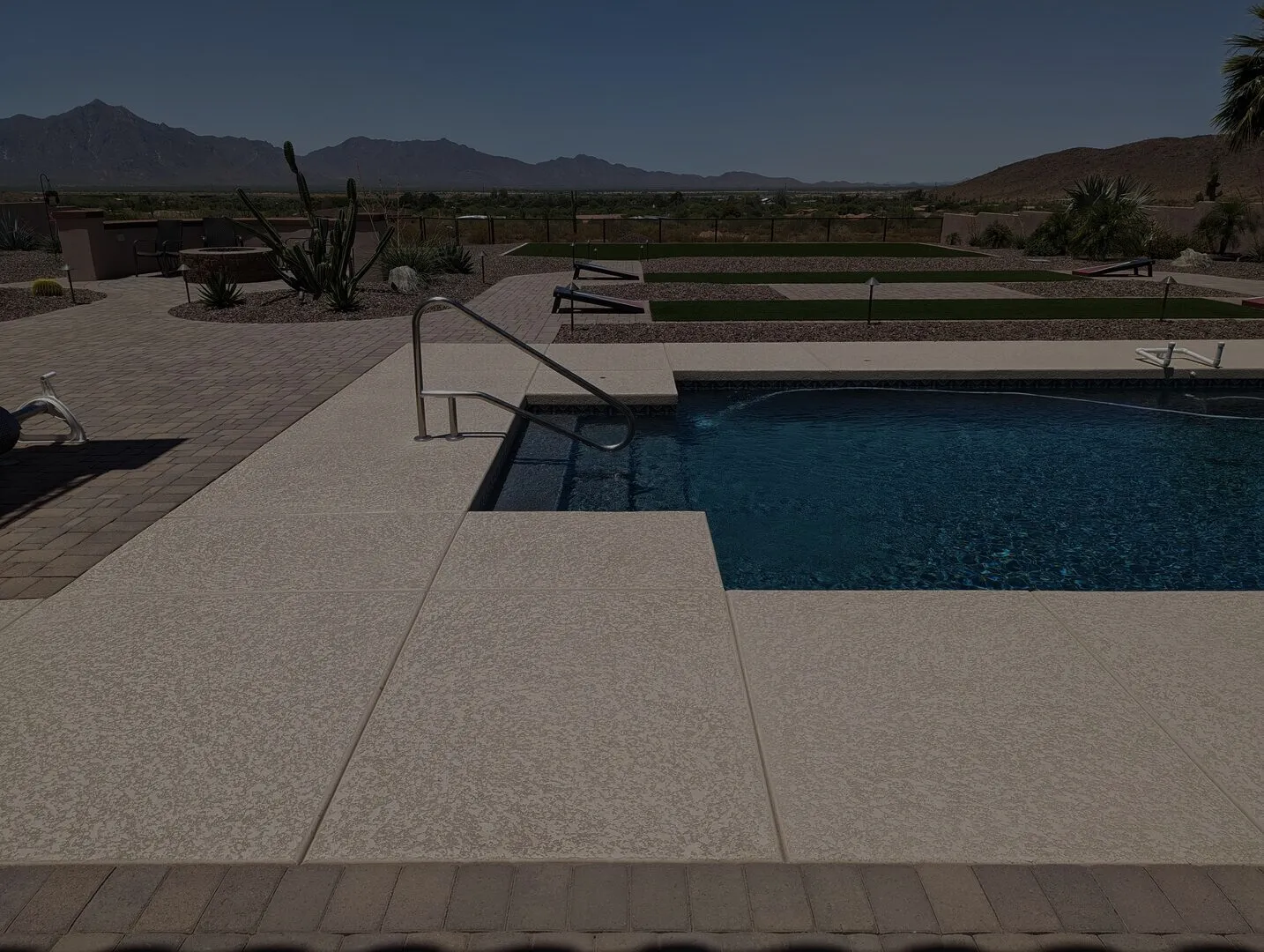




You booked the patio for the second week of July. The crew ground and prepped on Monday, coated on Tuesday morning, and a storm cell came off the Superstitions Tuesday afternoon and dumped a half inch in twenty minutes. Now there are rain craters across half the slab.
Monsoon season concrete work is not impossible in the Valley. It is just the one time of year when the calendar cannot be the only input. From roughly the middle of June through the end of September, Phoenix gets a combination of conditions that no other part of the country deals with at the same time: extreme surface heat, a real jump in dew point, blowing dust, and rain that arrives with almost no warning.
Here is how professional crews actually schedule around it, and what you should expect a contractor to tell you if you are trying to book exterior work in the middle of it.
What the monsoon actually changes
Most homeowners think the monsoon risk is rain. Rain is the obvious one. It is not the one that causes the most callbacks.
The bigger variable is dew point. For most of the year, Phoenix runs a very low dew point, often in the twenties and thirties. During monsoon it climbs into the fifties and sixties. That change does three things to a coating job that dry-season scheduling never has to account for.
First, it changes how epoxy cures. Amine curing agents react with atmospheric moisture and carbon dioxide, and in high humidity that reaction produces a greasy, sometimes hazy film on the surface known as amine blush. If a second coat goes over unwashed blush, it does not bond. That failure shows up months later as intercoat delamination and it is completely invisible on the day of install.
Second, it changes condensation risk. Concrete carries thermal mass. A slab that baked to 145 degrees on Monday afternoon is still warm at 5 a.m. Tuesday, but a slab in shade, or one that got soaked by a Monday storm and cooled by evaporation, can drop below the dew point overnight. Coating a surface with invisible condensation on it is a guaranteed adhesion problem.
Third, it changes drying time for everything water based. Acrylic sealers, cementitious overlays, water based primers. All of them slow down when the air stops accepting moisture, and slower cure means a longer window in which dust, wind and rain can get to a soft film.
Dust is the quiet problem
A haboob does not need to hit your street to cost you a job. Outflow winds ahead of a storm cell push fine desert dust for miles, and fine dust is exactly the particle size that settles into a wet coating and never comes out.
Dust in a wet film does two things. It creates a mechanical weak point at the surface, and on a clear topcoat it changes the finish from glossy to slightly cloudy in a way that no polishing recovers. On a metallic or a colored overlay, embedded dust reads as a gray cast over the whole pour.
This matters most on decorative work where the look is the product. It is the reason we sequence decorative concrete overlay installs early in the day during monsoon and stop well before the typical afternoon outflow window, rather than pushing to finish a slab because we are close.
The number to actually watch
If you take one thing from this article, take this. Surface temperature must sit at least five degrees Fahrenheit above the dew point, and it must stay there through the application and the early part of the cure.
That is the standard rule across the coatings trade, and during monsoon it is the rule that gets violated. Relative humidity on its own tells you very little, because RH changes as air temperature changes while the actual water content stays the same. Dew point is the stable number. A crew that shows up with an infrared thermometer and a sling psychrometer or a digital hygrometer, takes readings on the actual slab rather than reading a phone app, and writes those readings down, is doing it correctly.
Ask for those readings. A contractor who cannot tell you the surface temperature and the dew point at the time of application is guessing, and during monsoon guessing is expensive. Our epoxy floor installation timeline explains how those hold points fit into a normal project schedule.
Planning monsoon season concrete work around the forecast
A workable monsoon schedule looks different from a March schedule in four specific ways.
- Start earlier and stop earlier. Surface temperature is lowest just before dawn and afternoon storm risk peaks after two. The productive window shifts, so the working day starts in the dark and ends at lunch.
- Buy rain-safe time, do not hope for it. Every product has a point after application where rain no longer ruins it. For most exterior systems that is measured in hours, not minutes. The job gets scheduled so that window closes before the afternoon convection builds, not so it closes at the same time.
- Split the job differently. Prep, patch and prime on one day, build coat and topcoat on another, so that no single weather event can wipe out the whole install. It costs a mobilization. It saves a re-do.
- Keep a hard cancel rule. If the surface to dew point spread is under five degrees at the scheduled start, the crew does not coat. That decision gets made at 5 a.m. on site, not the night before from a forecast.
Reputable outfits will move your date. That is not a scheduling failure, it is the contractor protecting your warranty. A crew that will coat your patio coating in any conditions because the truck is already loaded is telling you something about how they handle everything else.
What is actually safe to do during monsoon
Not everything has to stop. Several categories of work are genuinely well suited to July and August, and some are better then than in the dry season.
Interior work carries almost none of the risk. A conditioned commercial space or an enclosed shop floor is climate controlled by definition, so a summer install has no weather exposure at all. Garage work sits in between, and we cover the heat side of that in more detail on our garage floor epoxy pages.
Surface prep is monsoon friendly. Grinding, shot blasting, crack chasing and patching can proceed on days that are too humid to coat, which is why a well run summer schedule front loads prep and holds coating days flexible.
Washing is fine, and in some ways better. Higher humidity means cleaners stay wet longer and work more effectively, and there is no rush to rinse before a surfactant dries on the slab. Our concrete wash and seal and paver and stone sealing crews stay busy through monsoon, with the sealing step held for the right window.
What genuinely should wait is exterior decorative work where appearance is the deliverable, and any exterior application over a slab that took direct rain in the previous 72 hours without adequate drying time.
The 72 hour rule after a storm
A soaked slab is not ready the next morning because the top looks dry. Concrete holds water well below the surface, and in monsoon the air is not pulling it out quickly.
Give an exterior slab at least 72 hours of dry weather after a significant rain before coating, and verify rather than assume. The field method is simple and it costs nothing: tape a square of clear plastic sheeting tightly to the slab, leave it in place overnight, and look at it in the morning. Condensation on the underside or a darkened patch of concrete means the slab is still releasing moisture. That is the same principle behind proper slab moisture testing, and during monsoon it is worth doing every time.
For a pool deck the rule tightens further, because the deck is already dealing with splash-out and irrigation. If you are planning a summer pool deck resurfacing, the realistic path is prep during monsoon and coat in October, or book the work for the spring window that our guide to resurfacing a pool deck before summer lays out.
Booking realistically
The Valley coating calendar is not evenly loaded. October through May is when exterior conditions cooperate, which means October and March are the two months everyone wants and the two months that book out first.
If you want exterior work done well, the practical move is to schedule prep during the monsoon and take an early fall coating date, or to book the spring slot several months ahead. Waiting until September to call about an October patio means competing with everyone else who waited.
We have been scheduling around Arizona weather for twelve years, and the crews plan monsoon jobs by dew point spread rather than by the calendar. Call our Chandler office at (602) 641-5892 or our Maricopa office at (602) 783-8803 and we will tell you honestly whether your project should go now or in six weeks.
Frequently asked questions
Can concrete coatings be applied during monsoon season in Phoenix?
Yes, with conditions. Interior work is unaffected. Exterior work is possible on mornings where the slab surface temperature sits at least five degrees above the dew point and the product will reach its rain-safe point before the afternoon storm window. Decorative exterior work where finish quality is the deliverable is usually better held until October.
How long should a slab dry after monsoon rain before coating?
Plan on at least 72 hours of dry weather, and confirm it rather than assume it. Tape a square of clear plastic to the slab overnight. If there is condensation under it in the morning, or the concrete beneath is darker than the surrounding surface, the slab is still giving off moisture and is not ready.
What is amine blush and why does humidity cause it?
Amine blush is a waxy or hazy film that forms on curing epoxy when the curing agent reacts with moisture and carbon dioxide in the air. High monsoon humidity makes it far more likely. It has to be washed off before the next coat goes down, or the coats will not bond to each other, and that failure typically appears months after the job is finished.
Is it better to wait until fall for exterior concrete work?
For exterior decorative work, generally yes. October through May gives lower dew points, moderate surface temperatures and no dust outflow risk. The catch is that the good months book out early, so the sensible approach is to have prep done during the summer and hold a fall coating date rather than starting the search in September.