


Every installer in the Valley has had this conversation. The customer looks at the single digit humidity reading on their phone, looks at the slab, and asks why anybody would test concrete for moisture in the middle of the Sonoran desert.
A concrete moisture test in Arizona is not optional, and the reason is the opposite of what people assume. Dry air does not mean a dry slab. In several important ways, dry air is exactly what pulls moisture up through concrete and puts it against the underside of your coating.
Dry air pulls harder
Moisture in concrete moves from areas of high vapor pressure to areas of low vapor pressure. The bigger that difference, the faster it moves.
A slab in a humid climate sits under air that is already carrying a lot of water. The gradient across the slab is modest and moisture leaves slowly. A slab in Phoenix in May sits under air carrying almost nothing. The gradient is enormous, and moisture in the slab and the soil beneath it is drawn upward hard.
Add extreme surface heating and it accelerates further. Heat at the top of a slab increases vapor pressure there and drives moisture ahead of it. On an exterior slab in a Valley summer, that thermal gradient runs every single day.
So the intuition is backwards. Low ambient humidity does not mean there is no moisture to worry about. It means whatever moisture is present is being actively pushed toward your coating.
Where the water comes from
The desert has no shortage of ways to get water under a slab.
- Irrigation. The largest source by a distance. Valley landscape runs on scheduled water, often several times a week for most of the year, and much of it goes into soil directly adjacent to concrete.
- Caliche. The cemented hardpan layer common in Sonoran soils is close to impermeable, so irrigation water perches above it instead of draining. That perched water can sit under a slab for a long time.
- No vapor retarder. Exterior flatwork poured decades ago in this market frequently sits directly on soil with nothing between. Many older interior slabs are the same.
- Pools and plumbing. A slow pool shell leak, a cracked return line or a supply leak under a slab feeds a very localized wet zone.
- Evaporative cooler and softener discharge. Both discharge continuously in season, and both frequently run onto or beside hardscape.
- Grading and drainage. Water that sheds toward a slab edge rather than away from it ends up underneath.
- New concrete. A freshly placed slab holds its mix water and needs real drying time regardless of climate. Fast surface drying in dry air can make a slab look ready long before it is.
Notice how many of those are things a homeowner controls. Fixing the source is almost always cheaper than mitigating the symptom.
How a concrete moisture test actually works
There are four methods in common use and they do not measure the same thing. Knowing the difference protects you from a contractor who waved a meter at your floor and called it tested.
In-situ relative humidity probes. Covered by ASTM F2170. Holes are drilled into the slab to a specified depth, sleeves are installed, the holes equilibrate, and probes read the relative humidity inside the concrete. This is the method that tells you what the slab is actually carrying through its depth rather than what is happening at the surface today. For any decision that matters, this is the test.
Anhydrous calcium chloride test. Covered by ASTM F1869. A weighed dish of desiccant sits under a sealed dome on the slab for a set period, then is weighed again to calculate a moisture vapor emission rate. It measures emission from roughly the top layer of the slab, which means surface conditions influence it heavily. In a climate that dries the top of a slab aggressively, this test can read low while the slab below is wet.
Plastic sheet test. Covered by ASTM D4263. Tape a plastic square to the slab, leave it, look for condensation. It is qualitative, it is free, and it is a screening test rather than a decision test. A positive result means stop and test properly. A negative result does not clear the slab.
Moisture meters. Non-destructive, instant, and genuinely useful for mapping a slab and finding the wet areas. They are comparative instruments, not pass or fail instruments, and no responsible specification is written off a meter reading alone.
The practical sequence is to use a meter to map, the plastic sheet as a free first screen, and relative humidity probes to make the actual decision on anything of value.
Reading the result
Coating manufacturers publish moisture limits for their systems, and those limits vary considerably between products and chemistries. The data sheet for the specific product being installed is the authority, not a general rule of thumb and not a number a salesperson remembers.
Ask for the test result and the product limit side by side. A contractor who has tested will have both. A contractor who has not will explain why testing is unnecessary in Arizona, which is the argument this article exists to correct.
What happens when a slab tests high
A high reading is not the end of the project. It changes the specification, and there are three real paths.
Fix the source. Where the moisture is coming from irrigation, a leak, cooler discharge or grading, correcting that and allowing the slab to dry is the cheapest and most permanent answer. It takes time, which is why testing early in the process rather than on install day matters.
Use a moisture mitigation system. Purpose-built moisture vapor barrier primers are designed to be applied to a damp slab and to hold back vapor pressure so the finish system above can be installed normally. They are an established solution with published limits of their own. They add cost and a step, and they work.
Use a breathable system. Rather than fighting vapor, let it through. Cementitious overlays, penetrating silane and siloxane sealers, and permeable acrylics allow moisture to pass rather than trapping it. On an exterior slab with a live moisture source this is often the smarter specification, and it is one reason a pool deck resurfacing is frequently better served by an overlay than by a film.
What does not work is coating a wet slab with a tight impermeable film and hoping. That produces blisters, delamination, and a repair that costs more than the original job.
Where this matters most in the Valley
Not every slab needs the full protocol. These do.
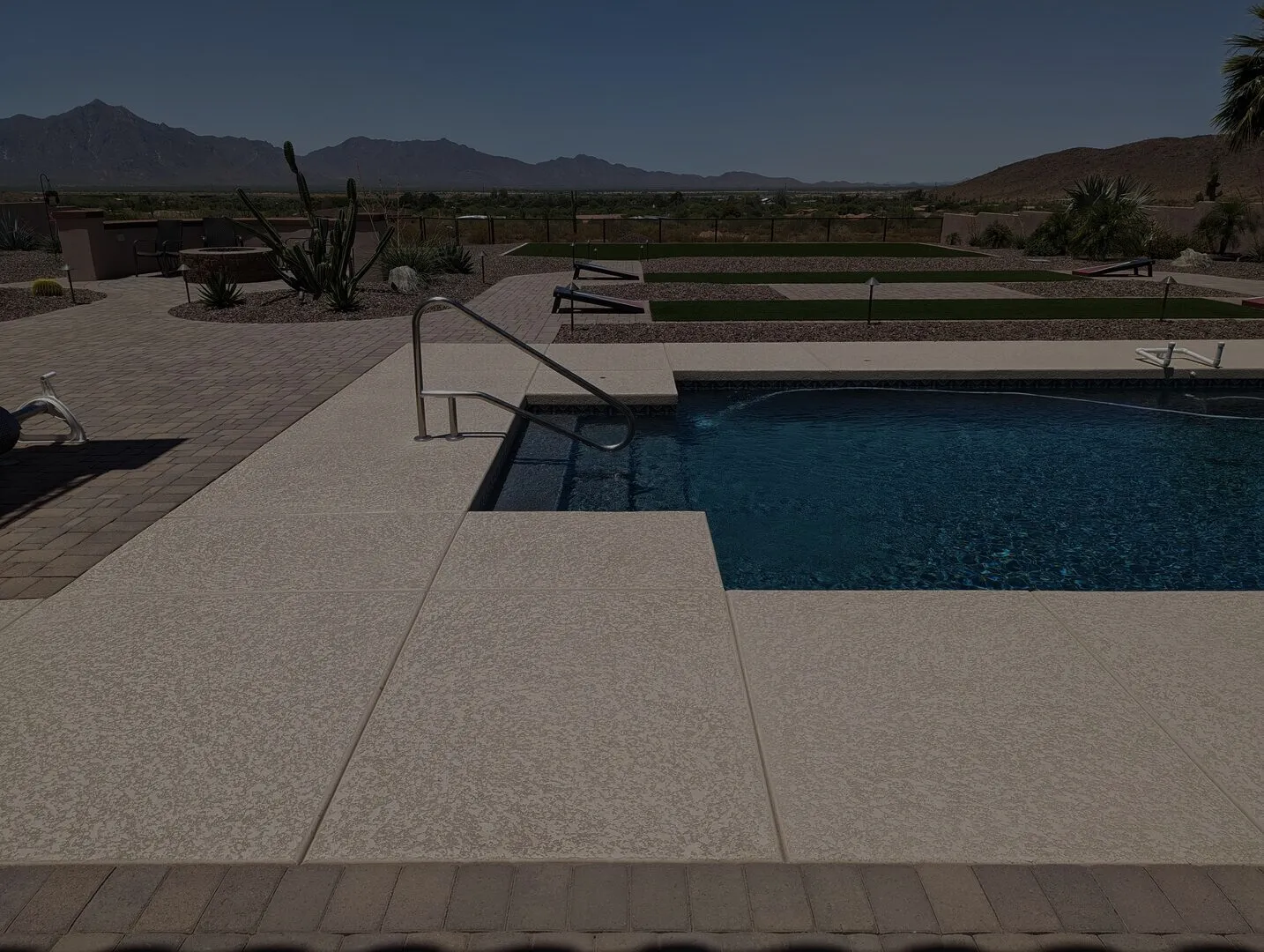
Pool decks, because they are surrounded by water on purpose. Patios adjacent to irrigated landscape, which is most of them. Any slab where a previous coating failed, because the failure is evidence and the cause has not been ruled out. Ground floor slabs in commercial and industrial buildings, where the coated area is large, the downtime is expensive and a failure takes a facility out of service. Slabs with any history of plumbing work. And basement floors, which are rare here but carry the highest moisture exposure of anything when they exist.
Our epoxy flooring replacement project is a useful illustration of why substrate condition drives the specification on commercial work rather than the other way around.
The cost of skipping it
Moisture testing is a small line item. A moisture driven failure is not.
When a coating delaminates because of vapor pressure from below, the repair is not a recoat. The failed material has to come off mechanically, the slab has to be tested and often mitigated, and the whole system goes back down. You pay for the floor twice and lose the use of the space twice. The blistering and bubbling that show up in that scenario are the same symptoms covered in our guide to epoxy floor repair, with a cause that a test would have found beforehand.
We have been testing and coating Valley slabs for twelve years, and moisture is the single most common reason we recommend a different system than the one a customer came in asking for. If you want a patio coating or an epoxy flooring installation that lasts, ask what the slab tested at. Call our Chandler office at (602) 641-5892 for a free estimate.
Frequently asked questions
Why test concrete for moisture in a dry climate like Arizona?
Because dry air increases the vapor pressure difference across a slab rather than reducing it, which pulls moisture upward faster, not slower. Combined with year-round irrigation, caliche that stops water draining away, older slabs poured with no vapor retarder, and the daily thermal gradient from extreme surface heating, Valley slabs routinely carry more moisture than the climate suggests.
Which concrete moisture test is the most reliable?
In-situ relative humidity probes, covered by ASTM F2170, because they measure conditions through the depth of the slab rather than at the surface. The calcium chloride test under ASTM F1869 measures surface emission and can read low in a climate that dries the top of a slab aggressively. The plastic sheet test under ASTM D4263 is a free screening check, and handheld meters are useful for mapping but are comparative rather than pass or fail.
Can a coating be installed on a slab that tests high for moisture?
Often yes, with the right specification. Purpose-built moisture mitigation primers are designed for damp slabs and hold back vapor pressure so the finish system can go down normally. Alternatively a breathable system such as a cementitious overlay or a penetrating sealer lets vapor pass instead of trapping it. What fails is putting a tight impermeable film over a wet slab.
What does a moisture related coating failure look like?
Usually round blisters rather than linear damage, often clustered in low areas or along the landscape side of a slab, sometimes containing liquid water, with the concrete underneath a popped blister noticeably darker than the surrounding surface. It commonly appears months after installation rather than immediately, which is why it gets misattributed to poor preparation.