


Your white metallic garage floor looked like poured pearl in March. By the following August the strip inside the door had gone the color of weak tea, and the rest of the floor had not moved at all. Nothing spilled on it. Nobody parked a hot tire on it. The line runs exactly where the afternoon sun falls through the open door.
That is epoxy yellowing, and UV is doing it. It is not a defect in your floor, it is a property of the resin, and it is entirely predictable once you know what to look for. Arizona has more of the input than almost anywhere else in the country, which is why this shows up here on floors that would have stayed white for a decade in Seattle.
Why standard epoxy ambers
The chemistry is worth two paragraphs because it explains every decision that follows.
Most flooring epoxy is built on a bisphenol A backbone. Bisphenol A contains aromatic rings, and aromatic rings absorb ultraviolet energy strongly. When they absorb enough of it, bonds break and rearrange, and the new structures that form absorb light in the blue part of the visible spectrum. A material that absorbs blue looks yellow to your eye. That is ambering, and once it has happened it does not reverse.
Aliphatic resins do not have those rings. Aliphatic polyurethanes, polyaspartics and quality acrylics are built without the aromatic structure, so there is very little for UV to attack in the first place. They hold color. This is the entire reason the trade separates coatings into UV stable and non UV stable, and it is not a marketing distinction.
Ambering is the first stage. The second stage is chalking, where the surface of the film erodes into a fine powder that comes off on your hand. Chalking is the resin physically breaking down, and once it starts the film is thinning, losing gloss, and eventually losing its ability to keep water out. A yellowed floor is a cosmetic problem. A chalking floor is on a clock.
Yellowing is not the same as fading
These get confused constantly, and the fix is different for each.
Ambering is the clear resin going yellow. It shows most on white, light gray, pearl and silver finishes because there is nothing in the color to hide it. On a dark charcoal floor the same amount of ambering is invisible, which is why dark colors appear to hold up better outdoors when the resin is degrading at exactly the same rate.
Fading is the pigment losing color, and it moves the opposite direction. A red or blue flake blend goes pale and washed out. A tan stain goes bone. Fading is about the pigment package, and inorganic pigments hold up far better than organic ones, which is one of the reasons earth tones survive Arizona exposure better than bright saturated colors. Our color charts are worth looking at with exposure in mind, not just taste.
You can tell them apart in thirty seconds. Move a planter or a floor mat that has been in place for a year. If the covered patch is whiter and brighter than everything around it, you have ambering, fading, or both. If the covered patch matches the color but the surrounding surface is dull and hazy, that is chalking, and the finish is eroding rather than shifting hue.
Where epoxy yellowing shows up in an Arizona home
Outdoors is obvious. The cases people do not expect are the ones that cause the complaints.
- The first eight feet of a garage. Every time the door goes up on a west facing garage, the afternoon sun lands on the same strip of floor. That strip ambers and the rest does not, which produces a hard line that reads as a stain rather than a gradient.
- Behind a garage door with window panels. Even with the door closed, panel glass puts a set of bright rectangles on the slab. Those rectangles amber first and they hold their shape.
- South and west facing interior glass. Standard window glass blocks most UVB but passes a meaningful amount of UVA, and UVA is enough to amber a coating over time. A living area or a sunroom with a resin floor and a wall of west glass will show it.
- Skylights and clerestory windows. Same principle, smaller footprint, sharper edges to the discolored patch.
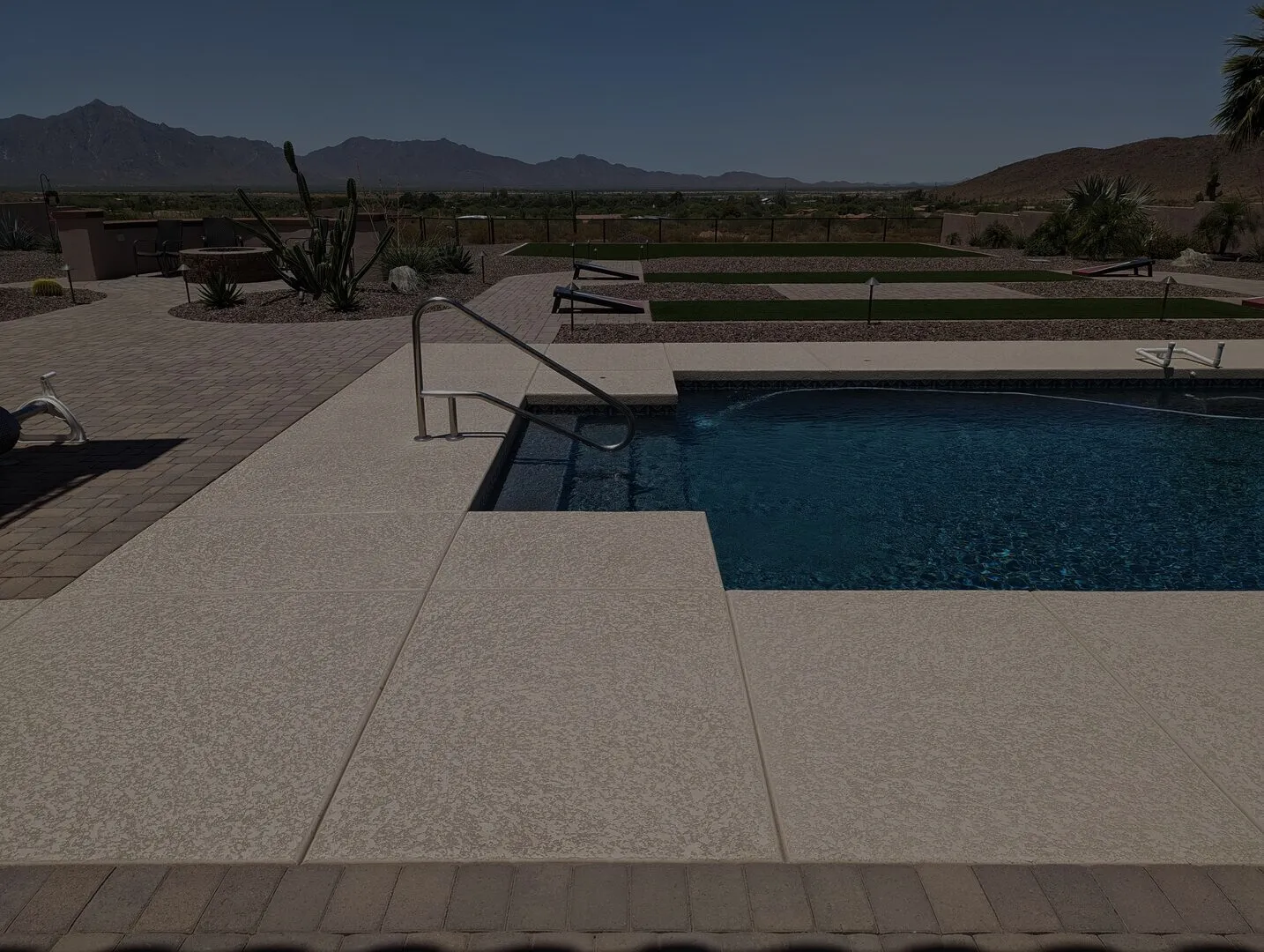
- Patios and pool decks. Full exposure, no filter, and the worst case for any non UV stable film.
This is why the specification for a patio coating is genuinely different from an interior warehouse floor, and why we do not simply carry the same system outdoors because a customer liked how it looked inside.
How the systems actually get built
The practical answer is not to abandon epoxy. Epoxy is an excellent primer and build coat. It bonds well, it fills, it is tough, and it is cost effective as a body layer. The answer is to keep it out of the sun.
A correctly specified exposed system puts an aliphatic wear layer on top. Epoxy primer and build coat, aliphatic polyurethane or polyaspartic topcoat. The epoxy never sees direct UV, the topcoat holds color, and you get the build and bond of one chemistry with the weathering of the other.
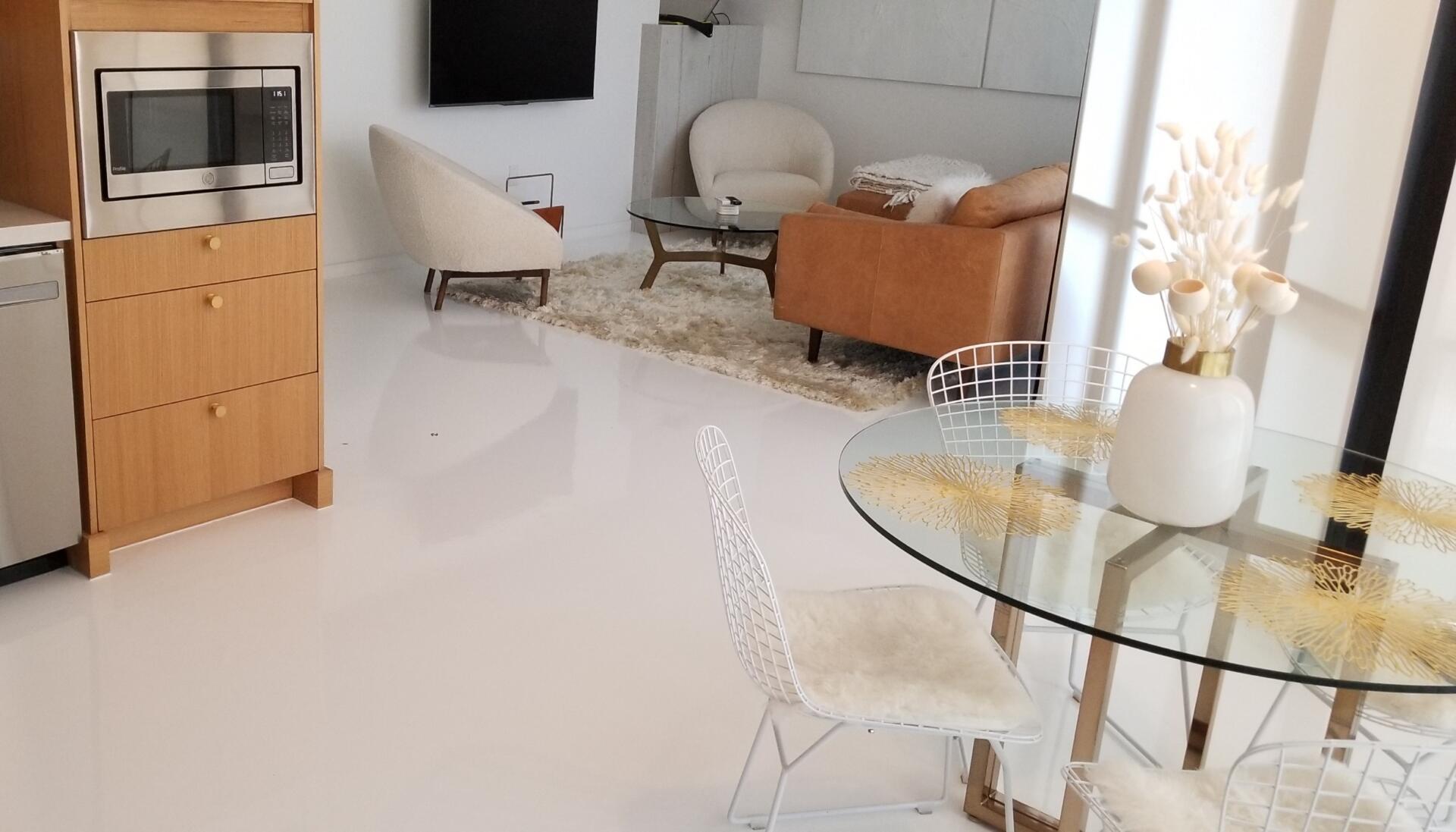
That layering matters most on decorative work where the color is the product. A metallic epoxy floor with an exposed epoxy clear coat will amber and take the metallic effect with it, because the effect depends on light passing cleanly through the clear layer to the pigment below. Put a yellow filter over that and the silver goes brass. The same system topped with an aliphatic clear stays true. If you are choosing a metallic finish for a space with real sun exposure, that topcoat decision matters more than the color you pick, and it is worth raising when you look at metallic epoxy for a garage floor.
Flake systems are more forgiving. A flake epoxy floor uses colored vinyl chips in a clear matrix, and the visual complexity of the blend hides a degree of ambering that would be obvious on a solid white. Forgiving is not the same as immune, and the topcoat still needs to be aliphatic if the floor sees sun.
What to ask before you sign
Three questions settle it, and any competent contractor answers all three without hesitating.
First, is the topcoat aliphatic or aromatic. If the answer is vague, that is the answer. Second, what does the warranty say specifically about discoloration and UV, because many coating warranties exclude color change explicitly, and you want to know that before the floor goes down rather than after it ambers. Third, what is the exposure on this specific surface, meaning which direction it faces and how many hours of direct sun it takes, because the correct product changes with that answer.
Our page on the pros and cons of epoxy flooring covers the wider tradeoffs, and the common misconceptions about epoxy floor coatings piece addresses several related beliefs that cost people money.
Fixing a floor that has already yellowed
Ambering cannot be bleached, buffed, or chemically reversed. The discolored resin is the resin.
What can be done is a recoat. If the film is sound and only the top has ambered, the surface gets mechanically abraded to a uniform profile, cleaned thoroughly, and topped with an aliphatic clear. The result is not a return to original color, because the ambered layer is still underneath and still visible through the new clear. It stops the progression, restores gloss, and takes the discoloration off its trajectory.
If the floor has moved past ambering into chalking, that is different. A chalked surface has no integrity for a new coat to bond to, and the chalk has to come off mechanically first. At that point the honest evaluation is whether a recoat is worth it or whether the system should be removed and rebuilt correctly.
We have been specifying coatings for Arizona exposure for twelve years, and this is one of the few failure modes that is completely avoidable at the quoting stage. Call our Chandler office at (602) 641-5892 and we will look at the actual exposure on your surface before anyone talks about color.
Frequently asked questions
Does all epoxy turn yellow in the sun?
Standard epoxy built on a bisphenol A backbone will amber under UV exposure, yes. That is a property of the aromatic chemistry rather than a product defect. What prevents it is not a better epoxy, it is an aliphatic topcoat such as a polyaspartic or aliphatic polyurethane that keeps the epoxy out of direct UV.
Can a yellowed epoxy floor be restored to its original color?
No. The color change happens inside the cured resin and cannot be bleached or polished out. A mechanical abrade followed by an aliphatic clear coat will restore gloss and stop the progression, but the ambered layer stays visible underneath. Full color recovery requires removing the coating and rebuilding the system.
Will my epoxy floor yellow if it is inside?
It can, wherever direct sun reaches it. Window glass blocks most UVB but passes UVA, so a floor beside south or west facing glass, under a skylight, or in the first several feet of a garage where the door opens will amber in those areas while the rest of the floor stays true. The result is a discolored patch with a hard edge rather than an even shift.
Which floor colors hide UV yellowing best in Arizona?
Darker and mid tone colors, and multi-color flake blends. White, pearl, light gray and silver metallic show ambering most because there is nothing in the color to mask a yellow shift. Colors built on inorganic pigments in the earth tone range also resist pigment fade better than bright saturated organic pigments.