


You type “best garage floor coating company near me” into your phone, and up comes a wall of five-star ratings, one-day-install promises, and quotes that somehow all sound the same. Then you read a little further and find the horror stories: floors that peeled in a summer, coatings that yellowed by the following spring, a crew that “found moisture” the morning of the job and doubled the number on the paper. Choosing the right company is less about who shouts the loudest and more about who can prove they will do the boring parts right.
We have installed floors across the Phoenix metro for 12 years, and we will tell you plainly: the difference between a floor that lasts and a floor that fails is decided long before the pretty topcoat goes down. This guide walks you through exactly what to ask, what to verify, and what should make you close the door, so you can compare any company against the standard our Arizona heat actually demands.
A quick note on how we are going to do this. We are not going to hand you a list of “top companies,” and we are not going to name anybody but ourselves. We are going to give you the criteria. Hold every contractor you talk to (including us) to the same bar, and the right choice tends to make itself obvious.
Why surface prep and product grade decide how long your floor lasts
Here is the part almost nobody puts in the sales pitch. The number one reason a floor coating peels, bubbles, or lifts is poor surface preparation. Not cheap product. Not bad luck. Prep. If the concrete is not ground down to open its pores and strip off the weak top layer (the industry calls it laitance), the coating bonds to dust instead of solid slab, and dust does not hold anything for long.
The professional method is diamond grinding. It profiles the concrete so the coating can mechanically lock in, and it takes off the oil, sealer, and old contamination that would otherwise wreck adhesion. Acid etching, by contrast, gives you an inconsistent bite. It barely touches oil-stained spots, skips over sealed sections entirely, and leaves you with a floor that grips hard in some places and almost nowhere in others. There are narrow cases where a light etch is defensible, a brand-new residential slab in clean condition being the usual one, but for a working Arizona garage it is not the tool for the job.
Product grade is the other half. A commercial-grade, multi-coat system behaves nothing like a single bucket of box-store epoxy, and out here that gap matters more than most homeowners realize. Summer garage temperatures regularly push past 130 degrees, winter nights drop into the 30s, and that swing puts a rigid, low-grade coating under thermal stress it was never built to survive. Add UV that runs well above the national average and monsoon-season vapor pushing up from under the slab, and a cheap system is on borrowed time from the day it cures.
So when you evaluate the best epoxy floor coating for your space, you are really evaluating two things a brochure rarely mentions: how the crew preps the concrete, and whether the system they install can take an Arizona summer without yellowing, chalking, or letting go.
8 questions to ask before you hire
Print these. Ask every company the same list, and pay as much attention to how confidently they answer as to what they say.
Are you licensed, bonded, and insured?
This is the floor, not the ceiling. In Arizona, a legitimate coating contractor should hold an active license with the Registrar of Contractors, and you can check it yourself in about a minute at roc.az.gov by searching the company name or license number. The ROC record also shows complaint history, which is worth a look. Bonding and liability insurance protect you if something goes wrong on your property. If a company gets cagey when you ask for a license number, you already have your answer. For the record, we are Licensed, Bonded, and Insured under ROC317029.
What system are you installing, and why?
You want a contractor who can explain the choice, not just name-drop. Epoxy, polyaspartic, polyurea, and acrylic overlays all have a place, and the right pick depends on your slab, your use, and how much direct sun the floor sees. A good answer sounds like a recommendation with reasons. A bad answer sounds like whatever they happen to have in the truck.
How do you prep the slab, grinding or etching?
Ask it straight. You are listening for “diamond grinding” and a real explanation of profiling. If the answer is sweep, wash, or acid etch and then coat, thank them and move on.
Do you include a primer, and how many coats?
A quality system is built in layers: a bonding primer or base, the color or metallic coat, and a protective topcoat. If someone is quoting a single coat over bare concrete, they are quoting a floor that will not last.
What does the warranty actually cover, and for how long?
This is where a lot of buyers get burned. Plenty of companies advertise long warranties that quietly exclude the exact things that fail in Arizona: moisture-related delamination, hot-tire pickup, UV yellowing. Read the exclusions, not the headline number. Our own coverage is one of the reasons we stand behind what we install, but the point holds for anyone: a warranty is only as good as what it does not carve out.
Can I see local Phoenix projects like mine?
Not a national portfolio. Local work, on slabs that have lived through the same heat as yours. A company that works in your area should be able to show you floors in your area.
How do you handle moisture in the slab?
This one flushes out a common tactic. Vapor moving up through desert concrete can lift a coating, so moisture should be part of the conversation up front, not a surprise “discovery” the morning of the install used to pad the bill. Ask how they test for it and how they mitigate it before anything gets coated.
Who is actually doing the work?
Ask whether the crew is trained and certified, or whether the job gets handed to whoever is available that week. The people holding the grinder decide how your floor turns out. We use Certified Installers for exactly that reason.
Red flags to walk away from
Some warning signs are loud enough that you should not wait around for the rest of the sales pitch.
High-pressure closing is the big one. “This price is only good today,” aggressive urgency, and a hard push to sign on the spot are tactics, not deals. A floor that lasts a decade can survive you sleeping on the decision for a night. Be just as wary of the day-of moisture upcharge, where the crew grinds, announces they have “found” moisture, and pressures you into an add-on fee that was never in the quote. Moisture is real and it matters, which is precisely why an honest company raises it before the contract, not after the grinder is running.
A few more that should stop you cold. A company that cannot or will not give you a license number. A crew that talks about “buffing” the floor or waves off prep as something that “doesn’t really matter.” Silence on UV protection, or the claim that a garage floor does not need it here (in Arizona, of all places). And a warranty nobody wants to email you in writing before you commit. Any one of these is a reason to keep looking.
How to compare proposals apples to apples
Two quotes are almost never the same floor, even when the bottom line looks close, and this is the single most useful habit you can build as a buyer: compare on scope, not on the number. Line them up by what actually gets done.
- Prep method: diamond grinding, spelled out, versus a vague “surface preparation.”
- System and coats: the specific products and how many layers, primer through topcoat.
- UV and heat rating: whether the topcoat is built to hold color in direct Arizona sun.
- Moisture plan: testing and mitigation described before the job, not discovered during it.
- Warranty terms: the coverage and, more importantly, the exclusions, in writing.
- Crew and credentials: who installs it, and their training.
When you stack proposals against that list, the cheapest paper often turns out to be the most expensive floor, because it is quietly skipping the steps that keep a coating stuck to your slab. Value and quality are not opposites. The goal is the company that does the whole job right, not the one that trimmed the parts you cannot see.
What good looks like in Arizona heat
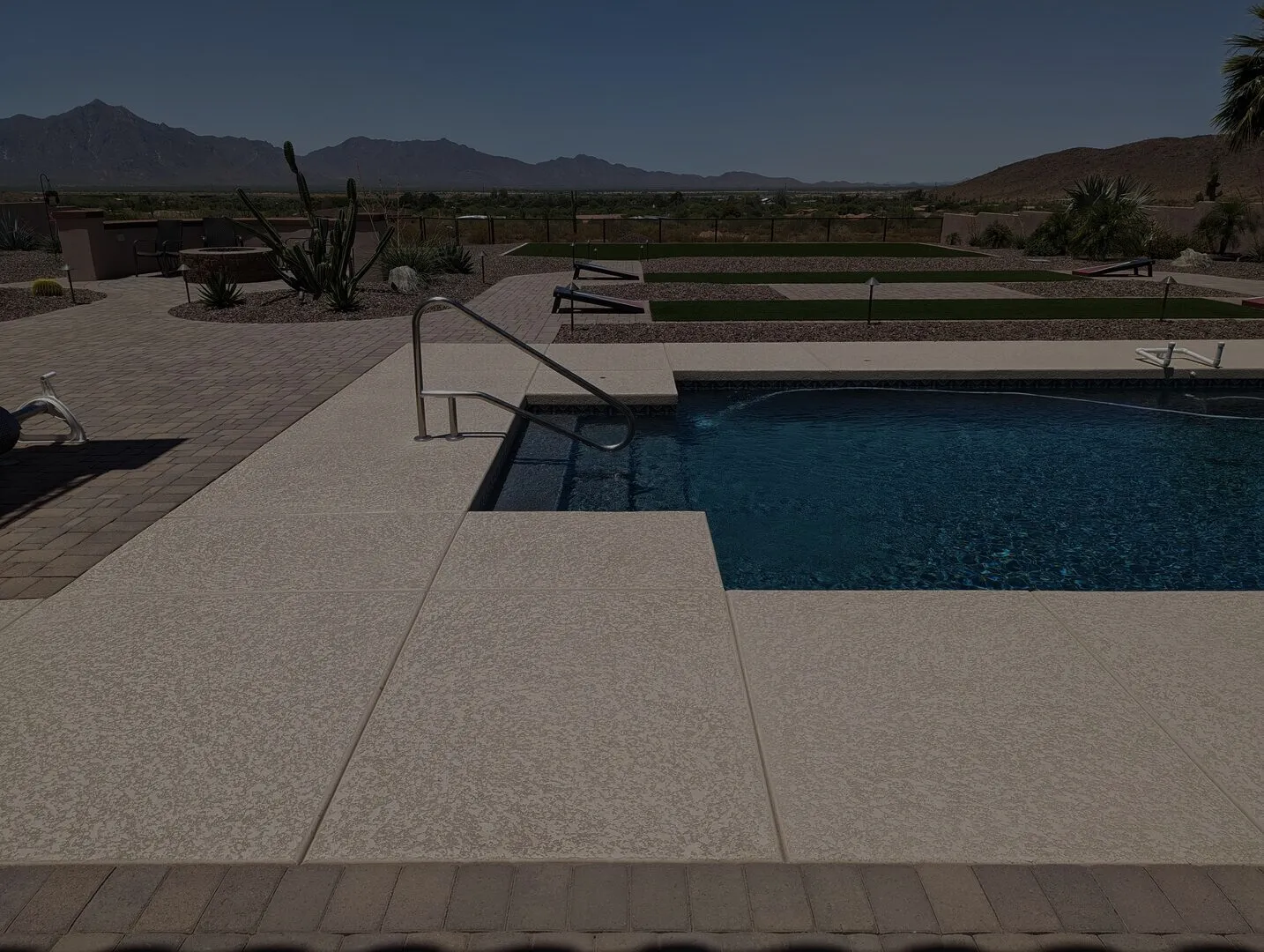
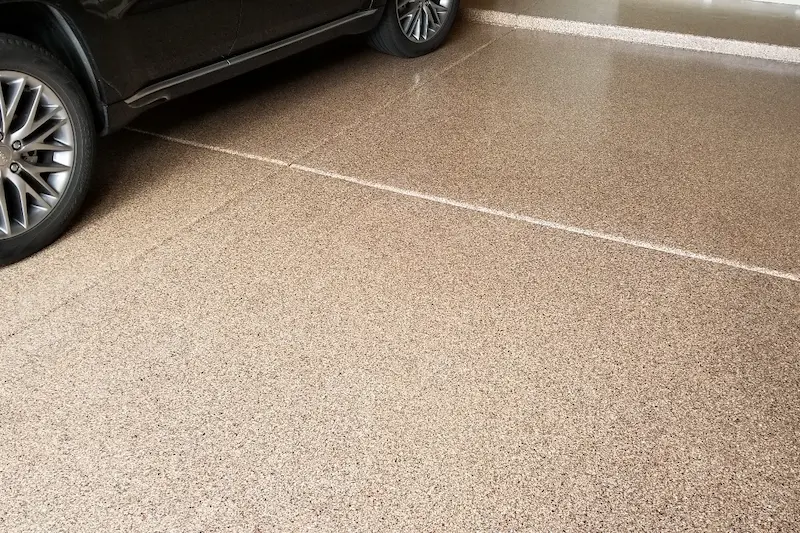
A coating built for this climate is a different animal from one built for a mild garage back east. It has to shrug off a slab that can top 130 degrees in July, hold its color under UV that is stronger than most of the country sees, and stay bonded through monsoon vapor and a triple-digit temperature swing between a summer afternoon and a January night. Standard low-grade systems can start yellowing within the first year out here. A properly specified, UV-stable, commercial-grade system installed over a correctly ground slab is what holds up, and it is the standard we build to on pool decks, patios, and garages across the Valley, from Chandler and Gilbert to Scottsdale and Tempe.
If you want to see the systems themselves, our metallic epoxy floors and commercial flooring pages lay out the options, and if your project is outdoor, the pool deck renovation and sports and games court pages cover the coatings built for sun and traffic. For a deeper read on vetting local installers, our top epoxy floor contractors in Phoenix page goes further.
Ready to compare? What to expect from a free estimate
Once you have your questions ready and you know what a strong proposal looks like, the last step is easy. A good estimate visit should include a look at your actual slab, a straight conversation about the right system for how you use the space, and answers to every question on your list without the runaround. You should walk away understanding what will be done, in what order, and why, before anyone talks numbers.
We are happy to be one of the companies you hold to this standard. Twelve years across the Phoenix area, Certified Installers, commercial-grade products, and a warranty we are glad to explain line by line. When you are ready, request a free estimate or call us at 602-641-5892, and put us up against every question in this guide.