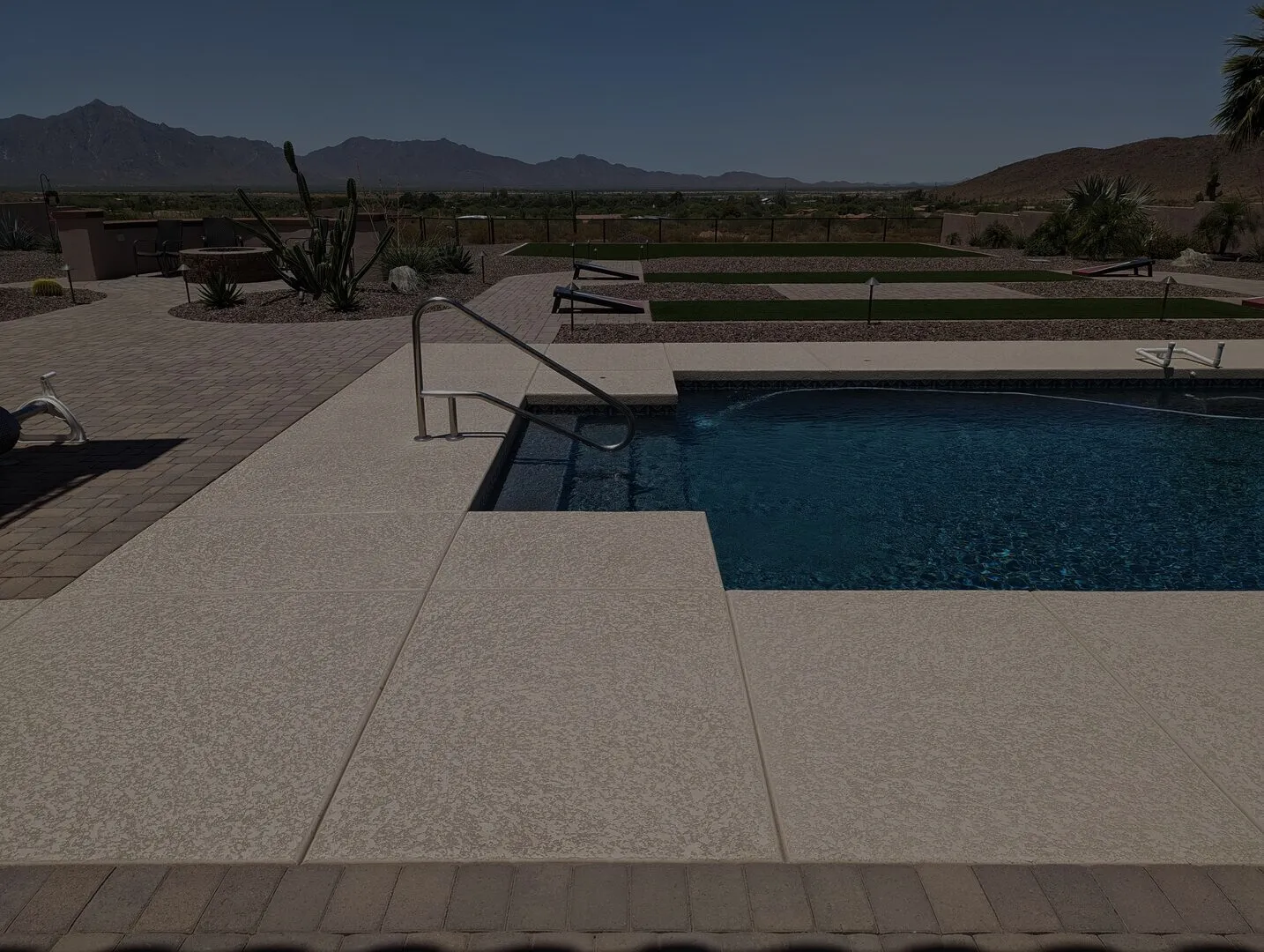



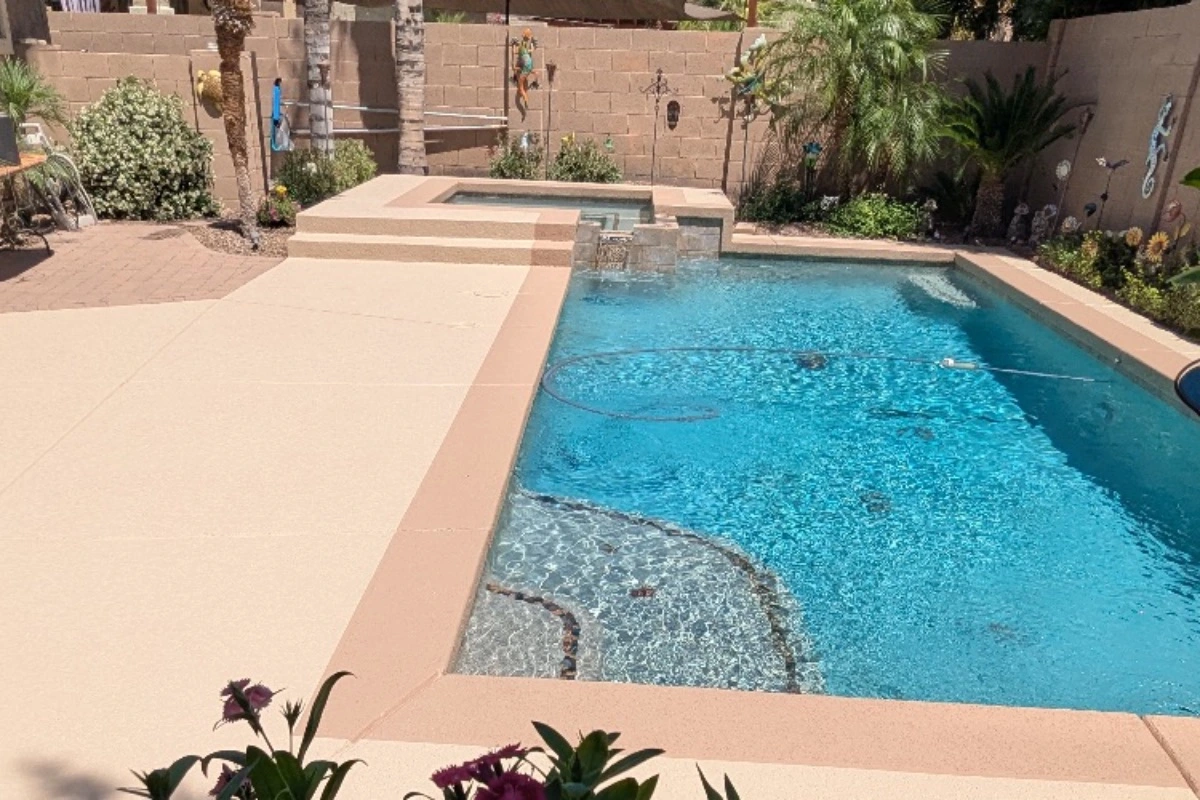
The deck looked great for two summers. Then one July you walked out barefoot, felt a soft spot near the west edge, and found a blister the size of a dinner plate. By August it had opened up and the gray concrete underneath was showing.
That is a pool deck coating failure, and in the Phoenix area it almost never happens for a mysterious reason. There are four mechanisms that do nearly all of the damage here, and each one leaves a different signature on the surface. If you can read the signature, you know whether the deck needs a spot repair, a full recoat, or a different system entirely.
This article is about the mechanism, not the symptom. If you are still at the stage of asking whether your deck is due for work at all, our guide to the signs your pool deck needs resurfacing covers what a homeowner sees. What follows is what is actually happening in the material.
Mechanism one: thermal cycling and differential movement
Concrete expands when it heats. So does every coating you can put on it. The problem is that they do not expand by the same amount.
Concrete has a coefficient of thermal expansion of roughly five and a half millionths per degree Fahrenheit. A cementitious overlay sits close to that number because it is essentially the same family of material. A film-forming polymer does not. Many epoxy and acrylic films move several times as much for the same temperature change, and some flexible urethane topcoats move more than that.
Now put real Phoenix numbers on it. A 110 degree afternoon does not mean a 110 degree deck. Surface temperature on unshaded concrete runs far above air temperature, and a mid tone deck in direct July sun climbs well past 140. That same slab drops into the seventies overnight in the shoulder seasons. Then a swimmer climbs out and drags a sheet of 82 degree pool water across a surface that was sitting at 150 a second earlier.
Every one of those swings makes the coating and the slab try to move different distances while they are glued together. The bond line takes the difference as shear stress. It survives that thousands of times, and then it does not. What you see is edge curling first, usually at a control joint or a slab edge where the film has a free boundary, followed by a blister that grows outward from that point.
Thermal cycling failures show up at boundaries. Joints, edges, the perimeter of a drain, the transition to coping. If your damage is concentrated at those lines and the field of the deck is still tight, you are looking at differential movement.
Mechanism two: UV breakdown of the resin
Standard epoxy is an excellent adhesive and a poor exterior topcoat. The chemistry that makes it bond so well, aromatic rings in the resin backbone, is the same chemistry that absorbs ultraviolet energy and breaks down under it.
The first stage is cosmetic. The film ambers, then goes chalky, and a wiped hand comes away with a fine powder on it. That powder is the degraded surface of your coating. The second stage is not cosmetic. As the top of the film erodes, it thins, loses its water resistance, and starts letting moisture reach the layer below. On a metallic or pigmented system the color goes flat and blotchy long before the film is gone.
Phoenix has a serious UV load and a very long sun season. A coating specification that works in Ohio has no relevance here. The exterior systems that hold up are the ones that use aliphatic chemistry in the wear layer, meaning polyaspartic, aliphatic polyurethane, or a UV stable acrylic in a cementitious overlay system. If you want the depth of an epoxy build coat outdoors, it belongs underneath an aliphatic topcoat, never exposed.
UV failures are uniform. The whole exposed field degrades at a similar rate, and the giveaway is that anything under permanent shade, the strip beneath a table base or the section under a shade sail, still looks close to original. If your deck has a color line that matches your shade pattern, UV did that.
Mechanism three: moisture drive from underneath
This is the one that surprises people, because the assumption is that a desert slab is a dry slab. It usually is not.
A pool deck is surrounded by water on purpose. It has a pool on one side, almost always irrigated landscape on the other, and in many Valley yards a drip system running under or beside the slab several times a week through the summer. Older decks in the Phoenix area frequently sit on soil with no vapor retarder at all, which was normal construction practice for exterior flatwork for decades.
Water in the soil moves toward the dry side. Heat accelerates it. When the sun bakes the top of the slab, vapor pressure drives moisture up through the concrete and it arrives at the underside of your coating. A breathable cementitious overlay or a penetrating sealer lets it keep going. A tight impermeable film does not. The vapor collects at the bond line, condenses when the deck cools, and lifts the coating in a soft dome.
Moisture blisters have a look you can learn in one minute. They are usually round rather than linear, they cluster in low spots and along the landscape side, they often contain a small amount of liquid water, and the concrete under a popped one is a darker gray than the rest of the deck. If a pool leak or a broken irrigation line is feeding it, the cluster maps to the leak.
The fix is never just a new topcoat. It starts with moisture testing and finding the water source, which is why we treat this separately from ordinary wear when we scope a pool deck resurfacing project.
Mechanism four: adhesion loss that started on day one
The fourth mechanism is not really a heat failure. Heat just makes it show up faster.
Coatings bond to a profiled, clean, sound surface. They do not bond to laitance, to a decade of pool chemical residue, to a previous acrylic sealer, or to a slab that was diamond ground but never vacuumed properly. If the prep was short, the coating is sitting on a weak layer, and in Arizona that weak layer gets tested by thermal cycling within weeks instead of years.
Three prep failures cause most of it. Grinding to too fine a profile, so there is nothing mechanical for the resin to key into. Leaving an old sealer in place and coating over it, which means the new system is only as attached as the old one. And coating a surface that still holds cleaning residue, especially after an acid etch that was not fully neutralized and rinsed.
There is a field test that settles the argument. Score a small square through the coating with a utility knife, press quality duct tape hard across it, and pull. Coating that lifts in clean sheets with bare concrete underneath and no concrete stuck to the film never had a bond. Coating that fights the tape and brings concrete crumbs with it was bonded, and your problem is one of the other three mechanisms. Our team walks through this on repair calls, and it is the same logic behind choosing between pool deck repair and full resurfacing.
Reading pool deck coating failure on your own deck
Take fifteen minutes on a morning before the surface gets hot, and look for pattern rather than damage.
- Damage concentrated along joints, edges and coping transitions, with a tight field: thermal cycling.
- Uniform chalking, color loss and ambering, with shaded areas still original: UV.
- Round blisters clustered on the landscape or pool side, sometimes damp inside, darker concrete underneath: moisture drive.
- Sheet peeling anywhere on the deck, clean back of the film, no concrete attached: adhesion failure from prep.
Two mechanisms often run together. A UV degraded topcoat lets water in, and water then breaks the bond. That is why a deck can look fine at four years and be beyond repair at six.
What an Arizona specific specification looks like
None of this means outdoor coatings do not work here. It means the system has to be chosen for this climate rather than pulled off a national spec sheet.
For most Valley pool decks that comes down to a few decisions. A cementitious overlay or a knockdown texture moves with the slab instead of fighting it, which takes thermal cycling largely off the table and gives you a textured concrete pool deck that stays walkable wet. Where a film build is wanted, the wear layer needs to be aliphatic so UV does not eat it. Where moisture is present, the system has to be permeable enough to let vapor pass, or the water source has to be fixed before anything is applied. And color matters more here than anywhere else, because lighter finishes run measurably cooler underfoot.
We have been installing coatings across the Phoenix metro for twelve years, and the decks that come back to us for warranty work are almost never the ones where the system was matched to the conditions. If you want a look at a full outdoor renovation in this climate, our pool and patio renovation in Scottsdale shows the approach on a commercial scale, and our pool deck sealing and coating page covers the maintenance side.
Call our Chandler office at (602) 641-5892 and we will look at the deck, identify which mechanism is running, and give you a free estimate for the work that actually addresses it.
Frequently asked questions
Does pool deck coating failure always mean the whole surface has to come off?
No. Adhesion failures and moisture blisters usually do require full removal in the affected zone, because anything you put on top inherits the same bad bond line. Thermal cycling damage confined to joints and edges can often be cut out and detailed. UV damage that has not yet let water through can sometimes be corrected with a mechanical abrade and a new aliphatic topcoat.
How hot does a Phoenix pool deck actually get?
Far hotter than the air. Unshaded concrete in direct July sun sits well above air temperature, and darker finishes run hotter than light ones. That gap between air temperature and surface temperature is the number that matters for coating performance, not the forecast.
Can a new sealer stop peeling that has already started?
It cannot. A sealer is a thin surface treatment, and it bonds to whatever is under it. If the layer under it is delaminating, the sealer delaminates with it. Sealing over an active failure hides the problem for one season and makes the eventual repair larger.
Is a west facing pool deck more likely to fail?
Yes, and it is usually the first area to show damage. West and southwest exposures take the hottest part of the day, hold heat longest into the evening, and cycle through the widest daily temperature range. When we inspect a deck, that is where we start looking.