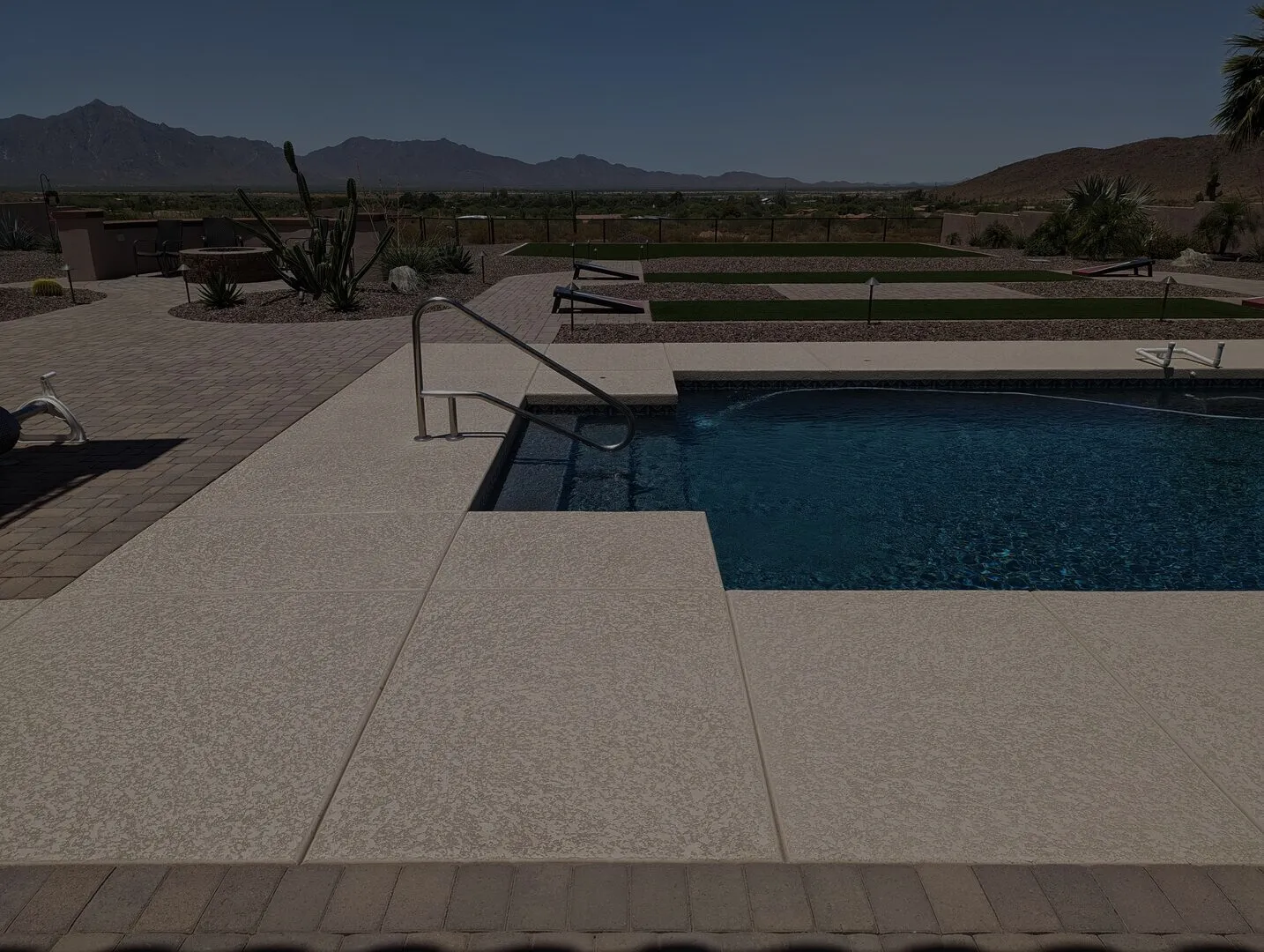



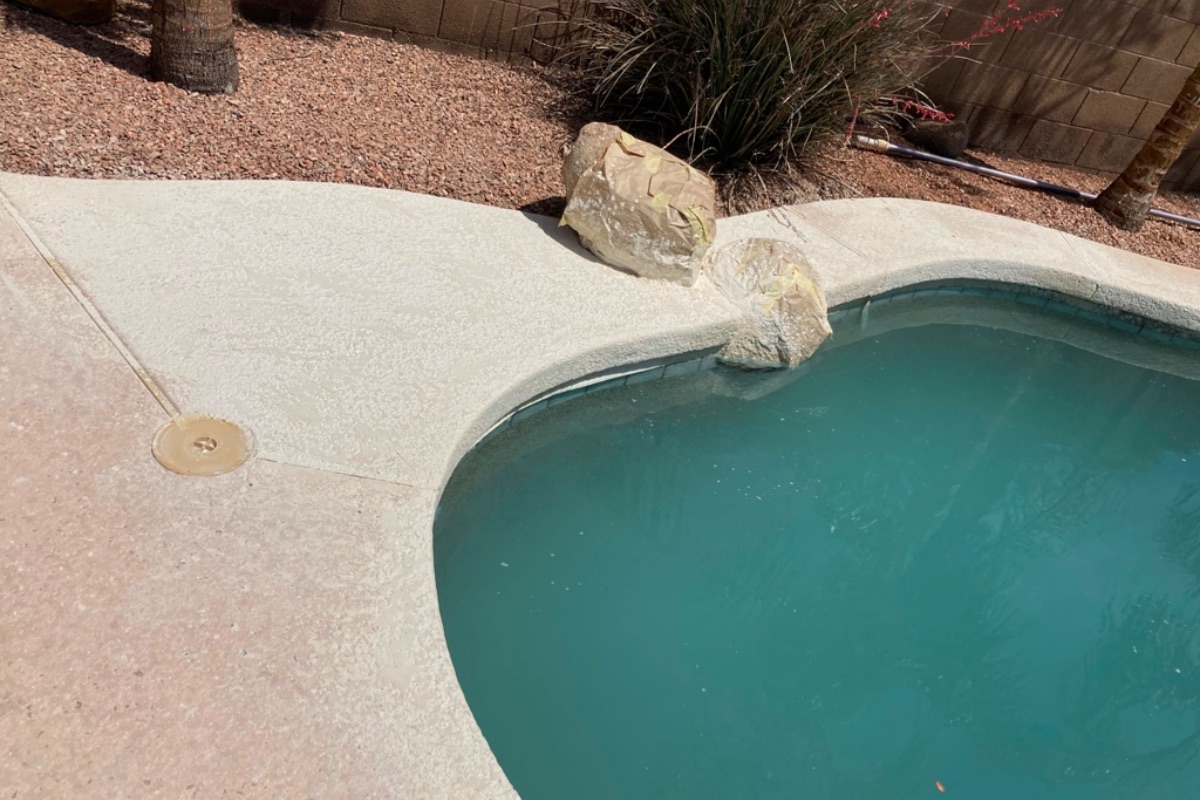
Look at the three feet of deck closest to your pool, then look at the far corner by the gate. If the near strip is duller, rougher, or a shade lighter than the rest, you are seeing chemical wear. It did not come from foot traffic. It came from your water.
Pool chemicals damage deck coating systems in ways that are slow, cumulative and easy to blame on something else. Most people attribute it to sun or age. In the Valley, where decks stay in service twelve months a year and evaporation concentrates everything, chemical exposure often does more measurable damage to the first few feet of deck than UV does to the whole surface.
Chlorine oxidizes the surface of the film
Chlorine is an oxidizer. That is the entire point of it, and it does not stop working when it lands on your deck.
Splash-out carrying free chlorine sits on the coating and slowly attacks the resin at the surface. On a clear topcoat the first visible sign is gloss loss. The near-pool strip goes flat while the rest of the deck stays sharp. Next comes microroughening, where the surface starts to feel slightly chalky underfoot and holds dirt in a way it did not before. On a colored system, oxidation lightens the pigment at the surface, which is why a splash zone can look sun bleached even where it is shaded.
Normal pool water at a properly balanced free chlorine level does this slowly. What accelerates it dramatically is shock treatment. Superchlorinating puts the free chlorine level far above normal, and anything that splashes onto the deck during and just after a shock is far more aggressive than day to day pool water.
The worst single case we see is undissolved product. A chlorine tablet dropped on a wet deck, or a scoop of granular shock spilled and not swept up, will bleach a permanent light spot into a coating within hours. Those marks do not clean off. They are damage to the film, not soil on top of it.
Acid is faster and more destructive
Muriatic acid is the one that ends a coating in a single afternoon.
Diluted hydrochloric acid is used routinely to lower pH and total alkalinity, and it is standard equipment in Valley pool maintenance. It also dissolves cement paste on contact. A splash on a sealed or coated deck strips the sealer, etches the concrete underneath, and leaves a rough light patch with a distinct edge. On a stained deck it takes the color with it.
Acid washing the pool interior is the version of this that catches people out. The acid goes in the pool, but the process involves handling, dilution, spilling and then neutralized water being pumped or drained across the deck. If your deck coating went bad shortly after the pool was acid washed, that is not a coincidence.
The prevention is not complicated. Wet the deck before handling acid so any splash is diluted immediately, pour into water rather than water into acid, and rinse the entire area heavily afterward. If a spill happens, flood it with water right away. Minutes matter. Once the etch is in the concrete, the repair is a resurfacing question rather than a cleaning one, which is where our pool deck repair work usually starts.
Salt systems are a different mechanism
Saltwater pools have a reputation for being gentle, and on skin and swimwear they are. On concrete they are not, and the reason is mechanical rather than chemical.
A salt chlorine generator runs the pool at a salinity that is low compared to seawater but far from zero. Splash-out carries that salt water onto the deck. The water evaporates, which happens quickly here, and the salt stays behind. Repeat that a few thousand times and salt accumulates on and in the surface of the concrete.
Where the surface is porous, salt solution wicks in, and then crystallizes inside the pore structure as it dries. Salt crystals occupy more volume than the solution they came from. The pressure that generates inside a pore is enough to break the surface of the concrete apart from the inside. That is subflorescence, and it produces scaling, spalling and a surface that crumbles under a fingernail. Unlike efflorescence, which is a cosmetic deposit on top, this one is structural damage to the top layer of the slab.
For a coating, the consequence is straightforward: the coating is only as sound as the surface it is bonded to. When salt breaks that surface down, the coating comes off with it, and the failure looks like delamination even though the coating itself never failed.
There is a second salt effect worth naming. Salt accelerates corrosion of embedded metal. Handrail anchors, ladder sockets, and any reinforcement close to the deck surface will corrode faster around a salt pool, and corroding steel expands, which cracks concrete outward from the anchor. Rust staining bleeding out from a rail base is the early warning.
What holds up and what does not
Chemical resistance varies enormously between systems, and it is not the same property as UV resistance or abrasion resistance.
Cementitious overlays and micro-toppings are permeable by design, which helps with vapor drive but means salt solution can enter. They need a good sealer to perform in a splash zone, and they need that sealer maintained.
Acrylic sealers are the most common product on Valley pool decks and the least chemically resistant. They are inexpensive to reapply, easy to work with, and they sacrifice themselves. Treated as a maintenance layer that gets renewed on a cycle, that is a reasonable system. Treated as a permanent solution, it disappoints.
Polyaspartic and polyurea topcoats hold up substantially better against chlorine and general chemical exposure while also handling UV, which is why they are the usual answer when a customer wants a coated pool deck that does not need attention every other year. That is the specification we generally recommend on a pool deck resurfacing where the deck sees heavy use.
Epoxy on its own does not belong on an exposed pool deck for this reason and several others, and a waterproof pool deck coating should be selected for chemical exposure as well as water resistance, because those are two different specifications that get conflated constantly.
Maintenance that actually changes the outcome
Five habits do most of the work, and none of them cost anything but attention.
- Rinse the deck after shocking. A hose pass over the splash zone within a day of a shock treatment removes concentrated chlorine before it does its slow work.
- Never store chemicals on the deck. Buckets sweat, tablets roll, granules spill. Storage belongs on a shelf in the shed, not on the concrete.
- Rinse the splash zone on a schedule during heavy use season. In a Valley summer the pool gets used daily and the deck never gets a natural rinse, since it does not rain enough to help.
- Check rail anchors annually. Rust bleed at a base is early, cheap and fixable. A cracked anchor pocket is not.
- Keep the sealer current. A sacrificial sealer only protects while it is there, and on a salt pool deck that interval is shorter than the label suggests. This is routine concrete wash and seal work.
Paver decks have their own version of this, since salt and chlorine attack the joint sand and the paver surface separately, and that is worth handling with the right paver and stone sealing product rather than a generic sealer.
When pool chemicals damage deck coating past a simple recoat
Chemical damage that is confined to the surface, meaning gloss loss and light discoloration with the film still sound, can usually be corrected with a mechanical abrade and a new chemically resistant topcoat.
Acid etch damage is different, because material is gone. The etched area sits lower than the surrounding surface and no coating hides a level change. It gets patched and re-profiled, or the whole deck gets a resurfacing so the repair does not read as a repair.
Salt scaling is the one to take seriously. If the surface crumbles when you scrape it, coating over it is throwing money away, because the new coating bonds to material that is already failing. That surface has to be removed down to sound concrete first, and depending on depth the answer is an overlay system rather than a coating. Our concrete overlay approach exists for exactly that condition, and a full pool deck renovation is sometimes the more sensible path.
We have been working on Valley pool decks for twelve years, and the ones that hold up are not the ones with the most expensive coating. They are the ones where the product was matched to the chemistry and somebody rinsed the splash zone. Call our Chandler office at (602) 641-5892 and we will look at what your water is doing to your deck.
Frequently asked questions
Is a saltwater pool harder on a concrete deck than a chlorine pool?
In a different way, yes. Salt damage is mechanical rather than chemical. Salt water splashes onto the deck, the water evaporates, and salt crystallizes inside the pores of the concrete, where the crystal growth breaks the surface apart from within. It also accelerates corrosion of handrail anchors and any reinforcement near the surface. Traditional chlorine attacks the coating film itself instead.
What should I do if I spill muriatic acid on my pool deck?
Flood the area with water immediately and keep flushing for several minutes. Acid dissolves cement paste on contact, so the amount of damage depends heavily on how fast it is diluted. Wetting the deck before you handle acid at all is the better habit, because a splash onto an already wet surface is diluted the moment it lands.
Why is the coating near my pool duller than the rest of the deck?
Oxidation from chlorine in splash-out. Chlorine attacks the resin at the surface of the film, which shows up first as gloss loss in the splash zone while the rest of the deck stays sharp. It is usually correctable with an abrade and a new chemically resistant topcoat if it has not progressed into the film.
Which pool deck coating handles pool chemicals best?
Polyaspartic and polyurea topcoats offer the strongest chemical resistance among the systems commonly used on residential decks, and they handle UV at the same time. Acrylic sealers are the most common and the least resistant, which is workable if they are treated as a sacrificial layer on a maintenance cycle rather than a permanent finish.