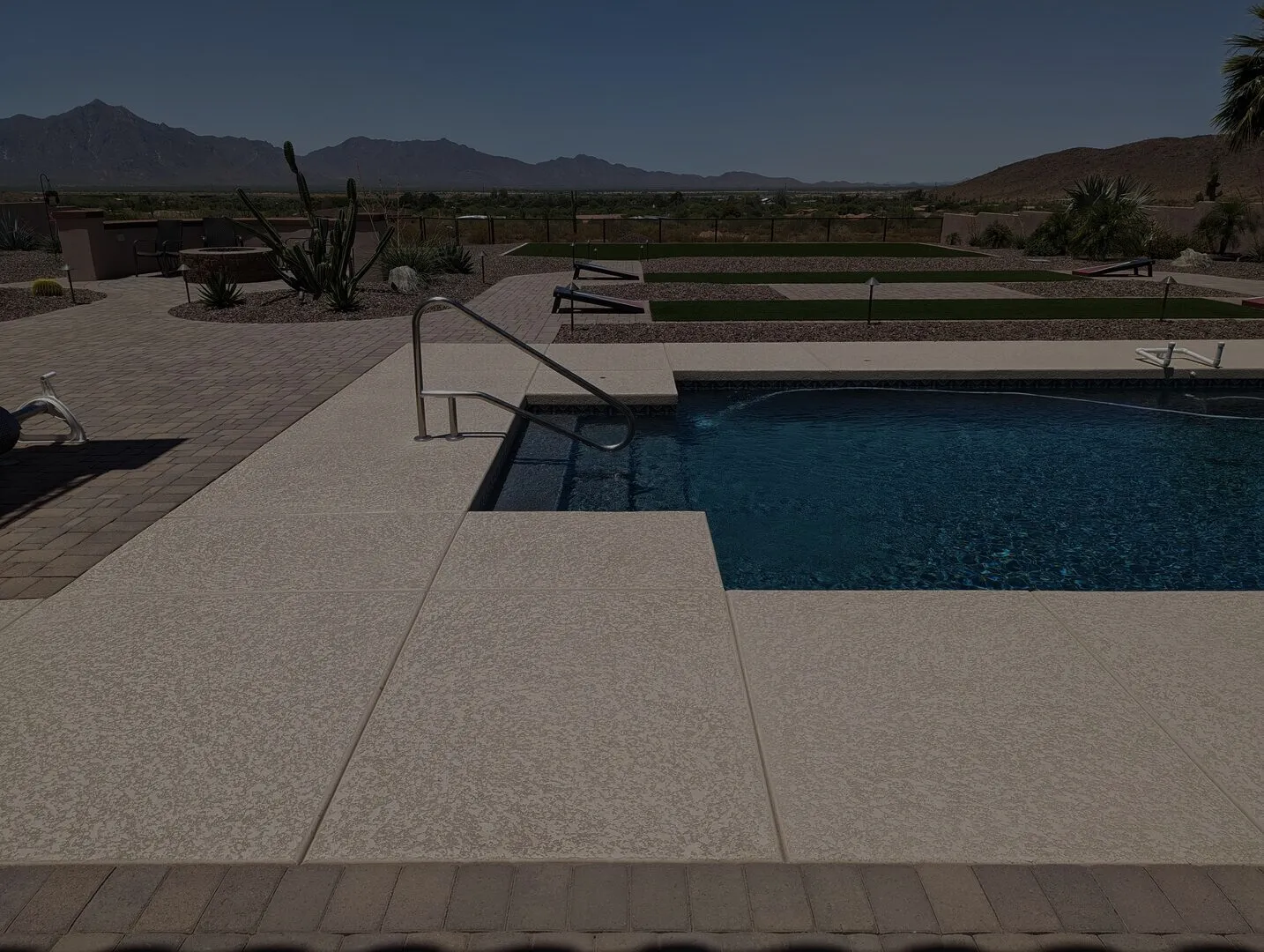




When an exterior coating fails in the Valley, it almost never wears out from the top down. It lets go at the bond line, and the failure was built in before the first gallon of product hit the slab. We have stripped enough peeling patios to say that with confidence.
Concrete prep in Arizona has three complications that crews in milder climates rarely face all at once: caliche hardpan under the slab, desert soils that move with moisture, and airborne dust that never really stops. Each one changes what preparation has to include. None of them show up in a quote that was priced over the phone, which is why two bids for the same patio can describe two very different jobs.
Caliche, and what it does to a slab from below
Dig almost anywhere in the Sonoran Desert and you will hit caliche, a pale hardpan layer of soil particles cemented together by calcium carbonate. For a coating contractor the problem is that caliche is close to impermeable, so it controls where water goes under and around a slab.
Irrigation water, drip lines and monsoon runoff that would drain away in normal soil instead perch on top of the caliche layer. That keeps the soil beside and beneath a patio wetter than the climate suggests. Moisture that cannot drain down has one direction left, and that is up through the concrete. A coating installed without knowing that is bonding to a slab with a slow moisture feed underneath it.
Caliche also forms in uneven lenses rather than a level sheet. A slab poured over it can bear firmly in one corner and softly in another, and that uneven support is a common source of the long straight cracks that keep reopening after they are patched. The crack is a symptom. The bearing condition is the cause, and no filler changes it.
Desert soil movement
The soils above the caliche have their own behavior. Parts of the Valley sit on expansive clays that swell when they take on water and shrink when they dry, and other parts sit on loose desert soils that can compress when they are wetted heavily for the first time. Add the pumping of groundwater that has caused measurable ground movement in parts of the metro over the decades and you get slabs that do not hold perfectly still.
For preparation, the question has to be answered crack by crack: is this crack finished moving or not? A dormant shrinkage crack from the original cure can be routed, filled and coated, and it stays fixed. A crack that opens and closes with the seasons will telegraph straight through a rigid coating, usually within the first year, along a clean line that follows the old crack.
Sorting one from the other is an assessment job, not a guess. The technique side of that decision is covered in our page on crack repair before coating installation, and the guide to epoxy floor repair for cracks and bubbles covers what repair looks like when a floor has already been coated. This article stays on the site conditions, because the conditions decide which of those techniques applies. A moving crack gets detailed as a joint with a flexible sealant. A dormant one gets a rigid repair. Treating them the same is how coated patios end up back on our schedule.
What exterior concrete prep in Arizona actually involves
Here is the sequence a Valley exterior slab needs before any coating, overlay or stain goes down. The order matters as much as the steps.
- Assess the slab. Map the cracks, sound the surface for hollow spots, test for moisture, and identify every coating or sealer already on it. Valley patios often carry two or three generations of acrylic sealer, and each one has to be accounted for.
- Remove existing coatings. Old sealer comes off by grinding or shot blasting, not by coating over it. A new system bonded to an aged acrylic is only as attached as that acrylic, and aged acrylic in Arizona sun is not attached well.
- Profile mechanically. The bare concrete then gets opened to the concrete surface profile the chosen system specifies. Diamond grinding gives the most control on residential work. Shot blasting covers large open areas faster. Both produce a repeatable texture the manufacturer can stand behind.
- Detail joints and cracks. Control joints exist to give the slab a place to move, so they stay honored rather than filled and coated across. Cracks that the assessment flagged as active get treated as joints with a sealant built to flex.
- Vacuum and contain. Every pass of grinding dust comes off with HEPA filtered vacuum extraction, not a leaf blower. Containment goes up on the windward side, because the desert will replace whatever dust you remove if you give it time.
- Coat promptly. The first coat goes on soon after the final vacuum. Every hour of delay is another film of airborne silt settling onto a surface that was clean.
None of this is exotic, and all of it takes time and machinery. That is the honest reason one bid for your patio is higher than another: one of them includes this sequence and the other includes a pressure wash and a promise.
Acid etching is not an equivalent substitute
Acid etching gets offered as a cheaper stand-in for mechanical prep, and for exterior Arizona work it is not one. The etch depends on the acid reaching bare cement paste evenly, which it cannot do through old sealer or through surface contamination. The profile it leaves varies across the slab. The residue has to be completely neutralized and rinsed, and the rinse pushes water into a slab that already has a moisture story underneath it thanks to the caliche. Grinding produces a controlled profile with no chemistry to neutralize and no water added.
The people most likely to reach for acid are homeowners doing their own garage, because the jug is cheap and the grinder rental is not. If that is your project, our DIY garage floor guide walks through the home version of this preparation honestly, including where etching falls short and what to do about it.
Dust is the Arizona specific problem
What Arizona adds on top of soil movement is dust that never fully stops. Desert silt is airborne here nearly all the time. Decomposed granite landscaping, which sits right up against most Valley patios, sheds fines every time the wind or a dog crosses it. A monsoon outflow can drop a visible gray layer on a clean slab in the minutes it takes to open a pail. Dust between a prepared surface and a wet coating is a bond breaker, and this environment manufactures it continuously.
Controlling it is part of the job, not an upgrade. Grinders run with vacuum shrouds and HEPA extraction so the dust is captured at the cut instead of broadcast over the yard. Containment stands on the windward side of the work. The final check before coating is old fashioned and reliable: wipe a clean white cloth across the slab, and if it comes away gray, the slab is not ready.
There is a second reason the vacuum matters. Dry grinding concrete without extraction puts respirable crystalline silica into the air, and OSHA maintains a specific standard for silica exposure on construction work for exactly that reason. A crew running a dry grinder on your patio with a dust cloud drifting toward the neighbor’s pool is telling you how they handle everything else on the job too.
Edges, transitions and the year after
Prep quality shows itself last at the edges. The slab border where coating meets dirt or decomposed granite, the transitions at steps and pool coping, the line where a patio meets the house slab: these are the places moisture and movement concentrate, and the places a rushed prep skips.
The first year is the real inspection, because the slab goes through its full cycle: irrigation, monsoon, winter nights and June heat. Preparation done right survives it without comment. Preparation skipped shows up as lifting edges, telegraphed cracks and hazing at the low spots.
Every exterior service we sell rides on this same foundation. A patio coating is only as good as the profile under it. A decorative concrete overlay is the most substrate-dependent finish we install, a thin cementitious layer that borrows its strength from the slab below. A stained concrete finish needs the pores open and clean or the color takes unevenly. And pool deck resurfacing adds water exposure on top of everything this article covers. That is why our quotes on this work follow a site visit and not a phone call. A price given without seeing the slab is a guess about the largest variable on the job.
The honest close
Not every slab needs all of this. Plenty of Valley patios are sound, uncoated and just dirty, and the right scope for those is a concrete wash and seal rather than a resurfacing project. Part of an honest assessment is saying so.
We have been preparing and coating concrete across the Phoenix metro for twelve years. If you want to know what your slab actually needs before you compare bids, call our Chandler office at (602) 641-5892 and we will look at it and give you a free estimate based on what is there, not on what the phone suggested.
Frequently asked questions
What is caliche and does it affect my concrete patio?
Caliche is a hardpan layer of soil cemented by calcium carbonate, common throughout the Sonoran desert. It is close to impermeable, so irrigation water perches above it rather than draining away, which keeps soil beside and under a slab wetter than the climate suggests. It also creates uneven bearing support, which is a common cause of straight-line cracks that keep reopening after repair.
Is acid etching good enough to prepare exterior concrete for coating?
Not for exterior work in this climate. Acid etching produces an inconsistent surface profile, leaves residue that has to be fully neutralized and rinsed, and adds water to a slab you are about to coat. Mechanical preparation by diamond grinding or shot blasting gives a controlled, repeatable profile and does not introduce either problem.
Why does dust matter so much when coating concrete in Arizona?
Because dust between the prepared surface and the coating is a bond breaker, and this environment produces it continuously. Desert silt is airborne almost all the time, decomposed granite landscaping sits right against most Valley patios, and monsoon outflow winds can drop a visible layer on a clean slab in minutes. Vacuum shrouded equipment, containment on the windward side, and coating promptly after the final vacuum are what control it.
How do I know if a crack in my patio can be coated over?
It depends on whether the crack is moving. A dormant shrinkage crack from the original cure can be routed, filled and coated, and it stays fixed. A crack driven by seasonal soil movement will telegraph through a rigid coating, often within a season. Assessment before the work starts is what tells you which one you have, and moving cracks should be detailed as joints rather than filled rigidly.