


A tennis court in Chandler in July is not a neutral surface. It is a large flat solar collector that has been absorbing energy since sunrise, and the people playing on it are standing on it, breathing air heated by it, and receiving radiant heat off it for two hours at a time.
Sport court surface temperature and heat performance is the one variable nobody discusses when a court gets resurfaced in this market. Everything else gets covered: color, speed, texture, line layout, cost drivers. The thermal decision gets made by accident, usually by picking a color because it looks like a professional venue on television.
The site already covers resurfacing process, court types and location specifics in depth. This is the part that is missing.
How an acrylic court is actually built
Understanding the layers explains most of what follows.
A standard acrylic court system starts with the base, either asphalt or concrete. Over that goes an acrylic resurfacer, a filled coating that levels and provides a uniform substrate. Then patch and leveling courses fill any birdbaths. Then two or more color coats, which are acrylic binders loaded with pigment and graded silica sand. Then the line paint.
The sand in those color coats is the texture, and the texture is what controls pace of play and traction. More sand means a slower, grippier surface. Less means faster. It also affects how the surface interacts with heat, because a textured surface presents less continuous contact area to a shoe sole than a smooth one, which is the same principle that makes a textured pool deck feel cooler underfoot.
The color coat is thin. It is the layer doing the thermal work, and it is also the layer that wears. That combination is why color selection matters more here than it does in a mild climate.
What drives sport court surface temperature in extreme heat
The surface absorbs whatever solar energy it does not reflect, and color is the dominant variable.
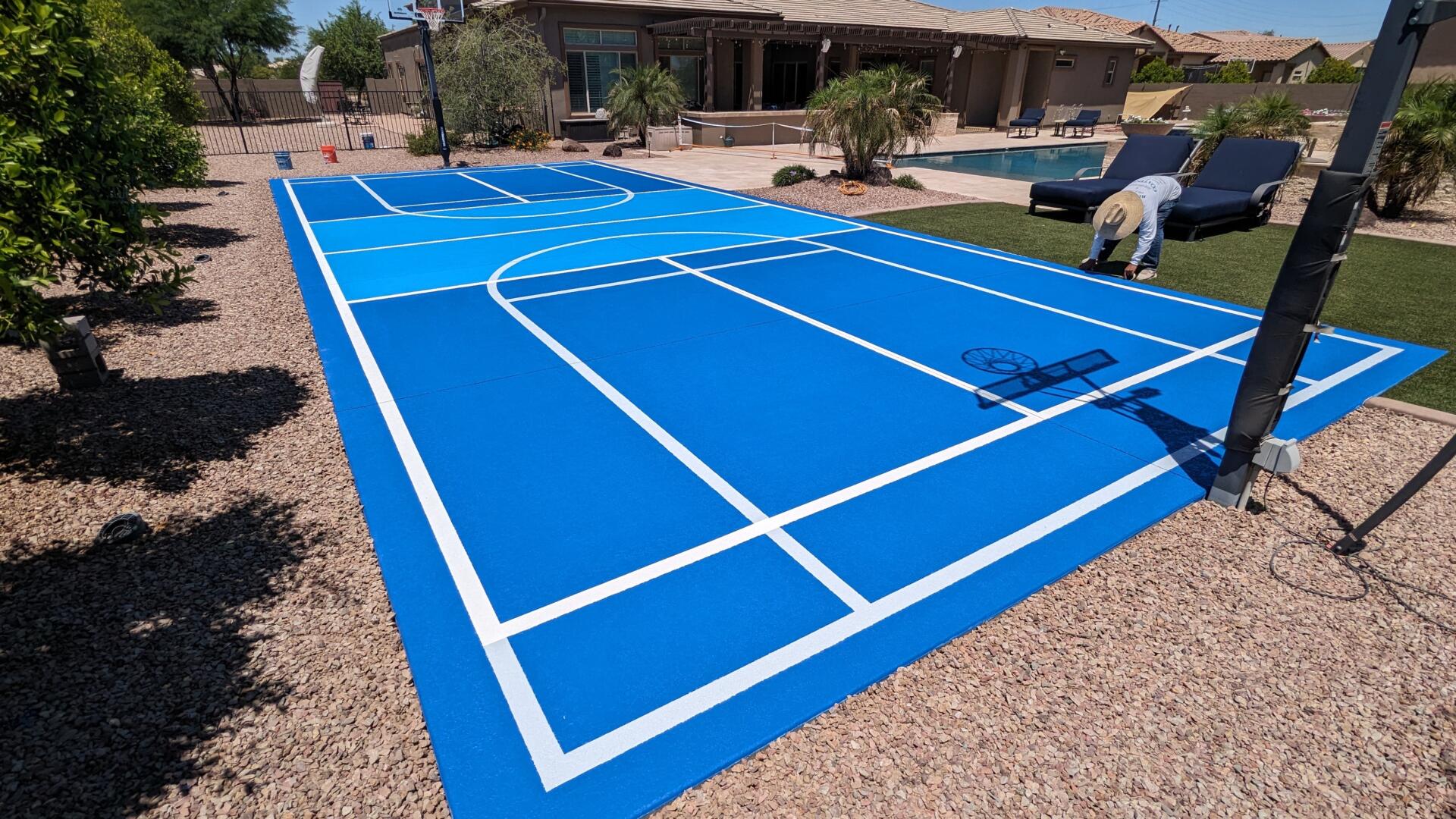
Dark greens and the deep blues that dominate professional venues absorb heavily. Lighter blues, light greens and grays reflect considerably more. In a Valley summer that difference is not academic. Put an infrared thermometer on a dark green court and a light blue court on the same afternoon and the gap is immediately obvious.
There is also a product category built specifically for this. Several court coating manufacturers produce color systems formulated with infrared reflective pigments, which reflect a portion of the near infrared energy in sunlight while still reading as a conventional court color to the eye. They allow a darker looking court to run cooler than its color would suggest. Ask about them by name when you get a quote, because they are not the default specification and they will not be offered unless you raise them.
The practical guidance for a backyard court in this market is straightforward. Go lighter than you think you want, keep the darkest color for the out of bounds area rather than the playing surface, and if you want the deep blue look, ask specifically about the heat reflective version of it. Our color charts are the place to start that conversation.
What heat does to the players
Court surface temperature affects athletes through more than one path, and the surface is a contributor to all of them.
There is radiant heat coming off the surface upward at the player. There is conductive heat through the shoe on every step. And the air immediately above a hot court is hotter than the air a weather station measures at standing height in the shade, which means the temperature a player experiences is not the temperature on the forecast.
Duration is what makes courts different from most other outdoor surfaces. Nobody stands on a hot driveway for ninety minutes. Players do exactly that, at high exertion, often in the afternoon.
Sports governing bodies publish heat policies for competitive play, and those policies exist because the risk is real. For recreational and backyard play the practical levers are the same ones every Valley athlete already knows: play early or late, use shade between games, and treat the surface temperature as part of the decision rather than only the air temperature. Anyone with a specific medical question about heat exposure should raise it with a physician rather than a coating contractor.
What heat does to the surface
The coating has its own problems.
Acrylic softens as it heats. On a very hot afternoon a court surface is measurably softer than it is at seven in the morning, and a softer surface scuffs and marks more easily under sliding shoes. Those marks are cosmetic, but they accumulate, and heavy summer afternoon play visibly ages a court faster than the same volume of play in spring.
Thermal cycling works on the substrate as well. Asphalt bases move more than concrete bases and soften considerably in Valley heat, which is why net post areas and high load zones on asphalt courts here can deform over time. A concrete base is more dimensionally stable and generally the better choice in this climate, though it brings its own crack control requirements.
Moisture under the coating behaves the same way it does on any slab. Heat drives vapor upward, and where an acrylic system is over a slab with a live moisture source, blistering follows. On a court, that shows as small raised areas that eventually break open under play.
And the recoat cycle is shorter here than the national norm for all of these reasons combined. A court in Phoenix works harder than the same court in a mild climate, and the maintenance schedule should reflect that rather than a manufacturer’s general guidance.
Application windows for court work in Phoenix
Acrylic court coatings have surface temperature limits like every other coating, and they are applied by squeegee in relatively thin, wide passes, which makes them especially sensitive to flash drying.
Coat a court surface that is too hot and the material skins over before it can flow out. The result is roller and squeegee marks, lap lines where one pass met the next, poor intercoat adhesion, and a texture that is uneven from one section to another. On a surface where uniform pace of play is the point, that is a functional defect and not just a cosmetic one.
This is why serious court resurfacing in the Valley happens in the shoulder seasons. Spring and fall give surface temperatures in range, low dust days, and no monsoon rain risk on a large horizontal surface that cannot be tented. Those windows book out well ahead, which is worth knowing if you are planning a project. Our court resurfacing in Arizona scheduling reflects that reality.
Design decisions that lower the temperature
Beyond color, several choices measurably change the experience of a court in this climate.
- Orientation. The standard north to south orientation is about sun in players’ eyes, and it is the right default. Where site constraints allow flexibility, think about which end takes late afternoon sun.
- Shade at the ends. A structure over the rest area rather than over the court itself is the highest value shade you can build. It does not affect play and it gives players somewhere to recover.
- Surrounding surfaces. A court ringed by dark hardscape sits in a heat island of its own making. Light colored surrounds and planting where possible reduce the reflected and radiant load.
- Cushioned systems. Rubber granule cushion layers under the color coats reduce joint impact and change the feel of the surface underfoot. They are a comfort and injury reduction decision more than a thermal one, and worth considering for players who spend real time on court.
- Fencing and airflow. Solid windscreen on all four sides stops air movement across the court. In this climate that tradeoff is worth thinking about, because moving air matters more than it does elsewhere.
Bringing it into a resurfacing conversation
When you get a quote for a tennis court resurfacing or a basketball court resurfacing, ask three questions that most people never ask.
What is the surface temperature difference between the color options you are showing me. Do you offer a heat reflective color system, and what does it change. And what is the realistic recoat interval for this surface in this climate, given how much sun it takes.
Those three answers tell you a great deal about whether the contractor has thought about where the court is being built. The rest of the specification, texture, layers, base preparation and line layout, is covered on our sports and games court and backyard courts pages, and our overview of court resurfacing across all sports surfaces covers the process itself.
We have been resurfacing Valley courts for twelve years and the ones that get used most are the ones somebody thought about heat on. Call our Chandler office at (602) 641-5892 for a free estimate, and raise the color question early rather than at the end.
Frequently asked questions
What color sport court surface stays coolest in Arizona?
Lighter colors. Light blues, light greens and grays reflect considerably more solar energy than the dark greens and deep blues used at professional venues, and the difference is easy to measure with an infrared thermometer on the same afternoon. Several manufacturers also produce heat reflective color systems using infrared reflective pigments, which let a darker looking court run cooler than its color would normally allow.
Does court surface temperature affect play?
Yes, in several ways. Acrylic softens as it heats, so a hot surface scuffs and marks more easily under sliding shoes and ages faster under heavy summer play. Players also take radiant heat off the surface and conductive heat through the shoe, and the air immediately above a hot court is hotter than the shaded air temperature on the forecast.
When is the best time of year to resurface a court in Phoenix?
Spring and fall. Acrylic court coatings are applied in thin squeegee passes and are highly sensitive to flash drying, so a surface that is too hot produces lap lines, uneven texture and poor adhesion between coats. The shoulder seasons give surface temperatures in range with no monsoon rain risk, and those windows book out well ahead of time.
Is a concrete or asphalt base better for a court in Arizona?
Concrete is generally the more stable choice in this climate. Asphalt softens considerably in Valley heat and moves more with thermal cycling, which can lead to deformation in high load areas such as net post surrounds. Concrete brings its own crack control requirements, so it is not maintenance free, but it holds its shape better under sustained heat.